Trump Claims Iran Nuclear Guarantee; Tougher MOU Terms Sent Back
Threat Level Assessment
LEVEL 4 OF 5, SERIOUS
Bottom Line Up Front
President Trump stated on 30 May that Iran has agreed to a guarantee of no nuclear weapons development, but a White House Situation Room meeting on Friday concluded without a final determination on the draft 60-day memorandum of understanding, and Trump subsequently sent tougher terms back to Tehran, per Axios and the New York Times. The MOU as negotiated by US and Iranian delegations includes an Iranian commitment not to pursue a nuclear weapon, a 60-day ceasefire extension, unrestricted shipping through the Strait of Hormuz, and a 30-day window for Iran to clear mines from the waterway; however, Trump wants the nuclear clauses strengthened before signing. Iran’s side simultaneously demanded $12 billion in frozen asset releases before substantive nuclear talks, contested Trump’s account of what was agreed, and moved in parliament to codify Tehran’s sovereignty over the Hormuz strait, a direct contradiction of a core US redline.
Key Judgments
No MOU has been signed. Both the White House and Iranian officials have publicly confirmed the memorandum of understanding has not been finalised. Trump’s own return of tougher terms to Tehran, reported independently by Axios and the New York Times on 31 May, confirms the negotiations are in a renewed back-and-forth, not a holding pattern ahead of signing. The Hormuz blockade and dual Iranian counter-blockade remain in effect.
The Iranian parliamentary move to codify sovereignty over Hormuz is a structural complication, not a tactical signal. Lawmaker Alireza Salimi’s statement on 30 May that parliament will “soon” vote to formalise Iran’s management of the strait is consistent with Iran’s 14-point negotiating framework and directly contradicts the US position that passage will be “unrestricted” with no Iranian tolls or control. If enacted, the law would give Tehran a domestic legal basis to reassert the very leverage the US blockade was designed to eliminate.
Whether Iran’s new supreme leader Mojtaba Khamenei has given final approval to any version of the MOU. PBS / AP reporting notes no definitive confirmation of Khamenei’s sign-off. The previous supreme leader was killed at the war’s outset; the new one has not appeared publicly since. His disposition on the nuclear concession language is the central unknown in this negotiation, and all other Iranian official statements may be positioning rather than a final posture.
| 60 Day MOU Window Proposed | $12B Iran Demands, Frozen Assets | 440kg HEU at 60%, Iran Stockpile | 30 Days to Clear Mines, Draft MOU |
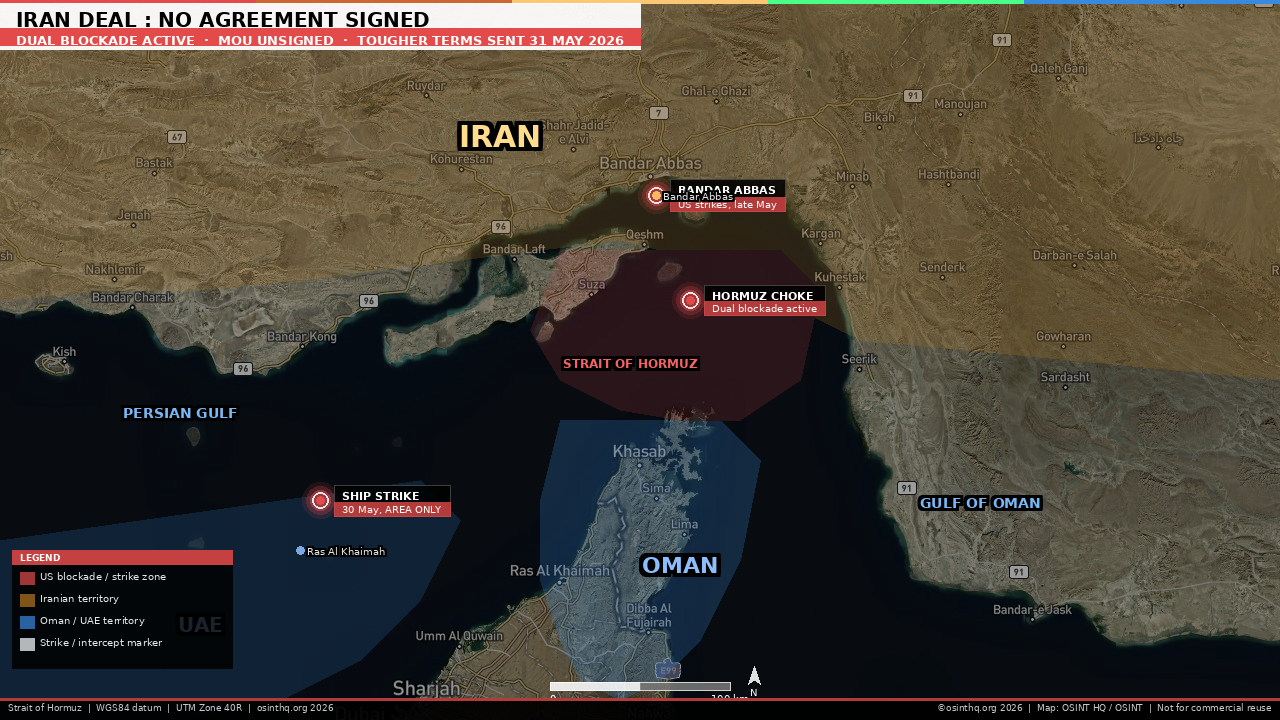
Strait of Hormuz choke point between Iran and Oman, showing Bandar Abbas, the dual blockade zone, and the 31-kilometre-wide navigable channel through which roughly 20 million barrels of oil per day normally transit. Territory and blockade fills approximate per AP / CENTCOM open-source reporting as of 31 May 2026. Map: OSINT HQ / OSINT. Datum WGS84, UTM Zone 40R. ©osinthq.org 2026
MGRS: 40RCQ 50000 94000 26.5667°N 56.2500°E Centre of the navigable choke point between Iran and Oman. ~31km wide at narrowest. Site of the dual US and Iranian competing blockades; central to the MOU negotiations. Source: Wikipedia infobox, Strait of Hormuz article |
MGRS: 40RCQ 52620 01250 27.1832°N 56.2789°E Iran’s principal port on the Hormuz strait. Site of the worst post-ceasefire fighting (US strikes on the port, late May 2026). Key commercial and military node under US naval blockade. Source: Wikipedia infobox, Bandar Abbas article | ||||
Approximate Area Centre of indicative zone. Exact site not publicly disclosed. CENTCOM confirmed a US missile strike into the engine room of a commercial ship attempting to breach the blockade and reach Iran on 30 May. Precise intercept position in the Gulf not disclosed by wire or CENTCOM. Source: Approximate per AP / CENTCOM statement, site undisclosed |
MGRS: 39SWB 53000 47000 35.6892°N 51.3890°E Iranian capital. Origin of government and Foreign Ministry statements on the MOU. City-centre reference point only; diplomatic activity occurs across multiple sites. Source: Wikipedia infobox, Tehran article |
SITREP Timeline : Iran War Diplomacy, Feb to May 2026
🔴 The Fox Interview and What Trump Actually Said
A Claim of Guaranteed Agreement, and Tehran’s Immediate Rebuttal
On Saturday night, 30 May, in an interview broadcast on the Fox News programme hosted by his daughter-in-law Lara Trump, President Trump stated that Iran had given him the one guarantee he required for any deal: that it would not develop nuclear weapons. The quote, confirmed across AFP wire, Axios, Gulf News, and the Asharq Al-Awsat English service, is a direct statement about Iranian agreement, not a conditional aspiration. In the same interview, Trump acknowledged he was in no particular hurry, saying that moving too fast would compromise the quality of any deal, and hinted that if terms were not met, the conflict would end in a different way, a formulation that carries obvious military implication.
The context around that claim matters considerably. The draft memorandum of understanding, as described by two US officials to Axios on 28 May, does include an Iranian commitment not to pursue a nuclear weapon. That is the clause Trump is likely referencing. But the draft also contains no specific mechanism for verifying or enforcing that commitment beyond a vague 60-day window during which the actual nuclear negotiations would begin. Trump’s request, per Axios reporting on 31 May, is to strengthen precisely that part before he signs, which means the guarantee he cited to Lara Trump is written in the draft but not yet embedded in a form he considers sufficient.
Tehran’s response to Trump’s characterisation was swift and sharply worded. Iranian state media, citing Foreign Ministry spokesman Esmail Baghaei, described Trump’s comments about Iran’s enriched uranium being destroyed as “baseless.” Iran’s Fars News Agency, whose relationship to the IRGC makes it useful for reading Iranian hard-line positioning, separately reported that the current draft contains no reference to dismantling or destroying nuclear materials. Both claims are labelled here as Iranian assertions and have not been independently verified against the draft text, which remains unpublished.
🟡 The Situation Room and the Tougher Terms
Two Hours in the Situation Room, No Decision, Then a New Ask to Tehran
Trump convened his national security team in the White House Situation Room on Friday 29 May with a stated intention of making a “final determination” on the MOU. The meeting ran approximately two hours, according to a White House official who spoke to multiple outlets. No announcement followed. A senior administration official, also speaking anonymously, told reporters the session concluded without a decision and that Trump would sign only an agreement satisfying his redlines and ensuring Iran could never possess a nuclear weapon.
The next day, 30 to 31 May, the New York Times and Axios reported that Trump had sent a revised framework back to Tehran with tougher terms. Axios, drawing on two US officials, specified that Trump’s primary concern was the nuclear program clauses. In the draft MOU as structured, the commitment not to pursue a nuclear weapon is present, but the 60-day negotiation window that follows is only loosely defined on outcomes. Trump wants to amend that section to tighten what Iran must concede and on what timeline. The exact language of the proposed amendments has not been made public.
This is not the first time a deal has appeared imminent and then been sent back for revision. In late May, both US and Iranian officials told reporters the agreement could be announced that weekend. It was not. The pattern of near-announcements followed by new rounds of back-and-forth reflects both the genuine complexity of the core issues and the negotiating posture of both sides, neither of which wants to appear to have conceded more than the other.
President Donald Trump : Fox News Interview with Lara Trump, 30 May 2026
“The one guarantee that I have to have is that there will be no nuclear weapons. They’ve agreed to that, and it was very interesting. They originally said ‘we will not develop a nuclear weapon’.”
🔵 The Hormuz Dimension
The Blockade, the Struck Ship, and Iran’s Move to Legislate Control
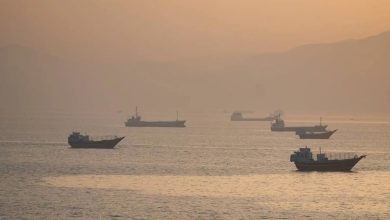
The navigable channel at the Strait of Hormuz, centred at approximately 40RCQ 50000 94000 (26.5667°N, 56.2500°E), is roughly 31 kilometres wide at its narrowest point and carries under normal conditions approximately 20 million barrels of oil per day, around one-fifth of global supply. Since 28 February, that traffic has been largely at a standstill. The US naval blockade, imposed on 13 April following the collapse of the Islamabad talks, is now enforcing a secondary chokehold on top of Iran’s own initial closure. CENTCOM has confirmed 33 vessels intercepted and multiple ships struck or disabled during the blockade period.
The most recent enforcement action came on 30 May, when CENTCOM fired a missile into the engine room of a commercial merchant vessel attempting to breach the blockade and reach Iran. The position of the intercept was not disclosed by either CENTCOM or wire sources; the coordinates card for this event carries AREA ONLY status. The US blockade seeks to limit Iran’s oil revenues, which CENTCOM has estimated at losses of $500 million per day to the Iranian economy. The ship strike is one of at least three such actions in the blockade period, alongside three vessels seized and multiple boardings.
On the same day as the ship strike, Iranian lawmaker Alireza Salimi, a member of parliament’s Presiding Board representing Tehran, told ISNA that Iran’s parliament would “soon” vote to formalise the Islamic Republic’s management and sovereignty over the Strait of Hormuz. He stated that as the strait passes through both Iranian and Omani territorial waters, no outside party would be permitted to make decisions about it. The US has explicitly rejected any form of Iranian control or tolling. If the parliamentary legislation proceeds, it codifies in domestic law the very position the US naval blockade was deployed to defeat, and it does so at the moment when both sides are supposed to be finalising language about “unrestricted” shipping.
🟡 Iran’s Position: Assets First, Nukes Later
Tehran’s Negotiating Sequence and Why the $12 Billion Demand Matters
Iran’s stated position, repeated across multiple official channels through late May, is that the release of $12 billion in frozen overseas assets is a precondition for any substantive movement on nuclear issues. Iranian state TV reported on 31 May that the draft deal in discussion includes this $12 billion release as its most important provision. Fars News cited a source close to the negotiations saying Iran would refuse further talks without the payment. The Iranian foreign ministry’s negotiating posture, as described by Baghaei on 29 May, centres on ending the war across all fronts, with nuclear discussions treated as a separate, subsequent file.
This sequencing is almost precisely the opposite of Washington’s priority ordering. The US wants the nuclear commitment locked in before sanctions relief flows. Iran wants the money before it discusses the bomb. The 60-day MOU window was designed to bridge this gap by running both processes in parallel: Hormuz opens, blockade lifts, ceasefire extends, and negotiations on enriched uranium disposal begin simultaneously. Trump’s revision request, per Axios, aims to front-load the nuclear concessions inside that window rather than leave them as the subject of a 60-day negotiation with no defined outcome.
The nuclear material at the centre of the dispute is Iran’s stockpile of 440.9 kilograms of uranium enriched to 60 percent purity, a technical step away from weapons-grade 90 percent, per IAEA data cited by PBS. The US priorities, as stated by the White House official after the Situation Room meeting, include disposal of this stockpile as one of the first items on the 60-day negotiating agenda. Iran’s enriched uranium, and the centrifuge infrastructure that produced it, survived the war. The PBS reporting as of late May notes that Iran’s stated war aims have not been achieved by the United States: the enriched uranium is still in Iran, the missile programme is described as being rebuilt, and proxy support continues.
⚠ Lebanon, Hegseth, and the Resumed War Option
Two Additional Complications Tehran Has Built Into the Negotiating Frame
Iran has insisted throughout May that Lebanon must be included in any final settlement of the war, a demand that intersects with a separate Israeli military campaign currently active in Lebanese territory. Beirut has accused Israel of a scorched-earth approach as Israeli forces advance and conduct further airstrikes against what Israel characterises as Hezbollah targets. The Axios-reported MOU framework would include Lebanon in its ceasefire scope, but the Lebanese element adds a third party to an already bilateral negotiation, and Israel’s alignment with whatever Washington signs is not guaranteed.
The US has not stepped back from the military option. Defence Secretary Pete Hegseth, speaking at the Shangri-La Dialogue in Singapore on 30 May, said the US was “more than capable” of resuming strikes on Iran if a deal was not reached, and that US munitions stockpiles were suited for both the Hormuz theatre and globally. CENTCOM separately posted on X that US forces remained “present and vigilant across the region.” Both statements are consistent with a maintained deterrence posture, not a de-escalation signal, and they appear to have been timed to coincide with the diplomatic pressure moment before Trump’s final decision.
Parliamentary Speaker Qalibaf, now the lead Iranian negotiator and a figure whose relationship with the new supreme leader has historically been close, made his own public statement on 30 May, saying Iran had rebuilt its military assets and that any resumed US attack would produce an outcome “more crushing and more bitter” than the opening of the war. Qalibaf’s statement, carried by state TV, was made after meeting Pakistan’s army chief, who is also meeting with Foreign Minister Araghchi, President Pezeshkian, and other senior officials as Islamabad maintains its mediating role. Qatar also sent a senior official to Tehran in support of Pakistan’s efforts.
Source Reliability Matrix
NATO grading: REL A (reliable) to F (unreliable). CRED 1 (confirmed) to 6 (cannot judge).
CRED 1
Primary wire for Trump Fox interview quotations. Confirmed across three independent outlets. Trump quote directly attributed and on-camera.
CRED 2
Primary scoop outlet for MOU details and Trump amendment request. Sourced to two unnamed US officials; confirmed by the White House to Al Jazeera. Cred 2 rather than 1 given anonymous sourcing of MOU specifics.
CRED 2
Corroborating wire for MOU, IAEA uranium stockpile figures, White House Situation Room outcome, and Khamenei sign-off status. CRED 2 given reliance on unnamed officials for the inner diplomatic detail.
CRED 1
Official US military statement confirming the blockade-busting ship strike on 30 May. Confirmed by AP / KSAT, the Intelligencer, and PBS cross-reporting.
CRED 3
Used only for Iranian government positions and domestic political signalling. All claims treated as assertions and labelled accordingly. Fars carries significant IRGC alignment and should not be treated as editorially independent.
OSINT HQ Assessment
A deal framework exists and both sides know what it says. Whether either side will accept the terms the other requires is a different question, and the gap on that remains wider than the public record suggests.
✓ What We Know
A 60-day MOU has been drafted by US and Iranian negotiating teams; it covers Hormuz opening, ceasefire extension, sanctions waivers, mine clearance within 30 days, and an Iranian commitment not to pursue a nuclear weapon. Trump did not sign it after a two-hour Situation Room session on 29 May. He subsequently sent tougher terms to Tehran, focused on strengthening the nuclear clauses. Iran’s FM Baghaei confirmed on 29 May that no deal was finalised. CENTCOM struck a blockade-busting commercial ship on 30 May. Lawmaker Salimi stated on 30 May that Iran’s parliament would vote to codify Hormuz sovereignty. Iran holds 440.9 kilograms of uranium enriched to 60 percent, per IAEA data. Iran’s missile programme is described as being rebuilt.
? What We Do Not Know
The exact text of the draft MOU and of Trump’s proposed amendments. Whether Mojtaba Khamenei has approved any version of the deal. Whether Iran’s $12 billion asset demand and the US nuclear strengthening request can be resolved in a single round. Whether the Iranian parliamentary Hormuz sovereignty legislation would be suspended or accelerated if an MOU were signed. Whether the US and Israel are coordinating on the Lebanon dimension. How long Trump’s “no hurry” posture holds before the military pressure option is reactivated.
☉ What To Watch
Whether Pakistan returns a revised Iranian response to Washington within days. Whether Iran’s parliament actually votes on the Hormuz sovereignty bill and when. Whether Khamenei makes a public appearance and signals approval or rejection. Whether global oil prices react to each announcement cycle, as they have throughout the war, providing a real-time market read on deal credibility. Whether CENTCOM continues blockade enforcement strikes and at what tempo. Whether Hegseth’s “more than capable” statement at Shangri-La translates into concrete military repositioning or remains declaratory deterrence.
Sources
- Trump says Iran has agreed to no nuclear weapons, AFP via Arab News, 31 May 2026
- Trump requests edits to Iran deal his envoys negotiated, Axios, 31 May 2026
- US and Iran reach deal but need Trump’s final approval, officials say, Axios, 28 May 2026
- US and Iranian negotiators reach tentative deal to extend ceasefire and start new nuclear talks, PBS NewsHour / AP, 28 May 2026
- US and Iran reach tentative deal for 60-day truce extension, officials say, Al Jazeera, 28 May 2026
- Trump ends Iran meeting without announcing final determination on deal, CNBC, 29 May 2026
- May 29 to 30 Iran war live updates, CNN, 29 to 30 May 2026
- US says it is capable to resume war with Iran as deal remains elusive, Euronews, 30 May 2026
- US says it struck a commercial ship trying to breach blockade and reach Iran, AP / The Intelligencer, 31 May 2026
- Iran parliament to vote on Hormuz Strait management plan soon, PressTV (Iranian state media assertion), 30 May 2026
- Trump says deal with Iran, including opening Strait of Hormuz, is largely negotiated, PBS NewsHour, 24 May 2026
- Trump on Iran: Slowly but surely, we’re getting what we want, Israel National News / Fox News, 30 May 2026
Editorial Verification
Trump’s Fox News interview quotations are verified across AFP wire (Arab News, France24, Gulf News, Asharq Al-Awsat English) and Axios (31 May): two or more independent sources, confirmed. The existence of the 60-day MOU draft is verified across Axios (28 May), AP/PBS (28 May), and White House confirmation to Al Jazeera: two or more independent sources, confirmed. Trump’s dispatch of tougher terms back to Tehran on 30 to 31 May is sourced to Axios (31 May) and New York Times (31 May), confirmed: two or more independent sources. The White House Situation Room outcome (no decision) is confirmed by a White House official across CNBC, CNN, Fox News, and PBS: confirmed. CENTCOM’s ship strike on 30 May is confirmed by official CENTCOM statement, AP, PBS, and The Intelligencer: confirmed. Iranian parliamentary Hormuz sovereignty bill statement is sourced to ISNA via PressTV (Iranian state media): single-source and treated as an assertion, not confirmed independently. Iranian claims about the drone shootdown (IRIB) are unconfirmed by US sources and labelled as assertions. All Iranian state media claims are labelled as assertions per editorial policy.
Coordinates and map (v8): Strait of Hormuz choke point (MGRS 40RCQ 50000 94000, 26.5667N 56.2500E) is PRECISE, sourced from Wikipedia infobox. Bandar Abbas (MGRS 40RCQ 52620 01250, 27.1832N 56.2789E) is PRECISE, sourced from Wikipedia infobox. Tehran reference coordinate (MGRS 39SWB 53000 47000) is INDICATIVE, sourced from Wikipedia infobox. Commercial ship interception position on 30 May is AREA ONLY per CENTCOM, precise position not disclosed. Static map to be produced with PIL overlay script sb-map-overlay.py on a satellite base image. Third-party watermarks removed from base before overlay. Territory fills and blockade markers are approximate per CENTCOM / AP open-source reporting. No classified imagery used.
MGRS datum: WGS84 / UTM Zone: 40R / Cross-check reference: Bandar Abbas port centre 40RCQ 52620 01250
All claims independently attributed and verified to open sources where possible.
Approved for Publication
Marcus V. Thorne
Lead Editor, OSINT HQ
©osinthq.org 2026
This article is for news and analysis purposes only. Based on publicly available news sources and military updates. All rights reserved. Not for commercial reuse without permission.