Israeli Forces Set Up Checkpoints in Quneitra and Daraa Syria
Threat Level Assessment
LEVEL 3 OF 5, DEVELOPING
Bottom Line Up Front
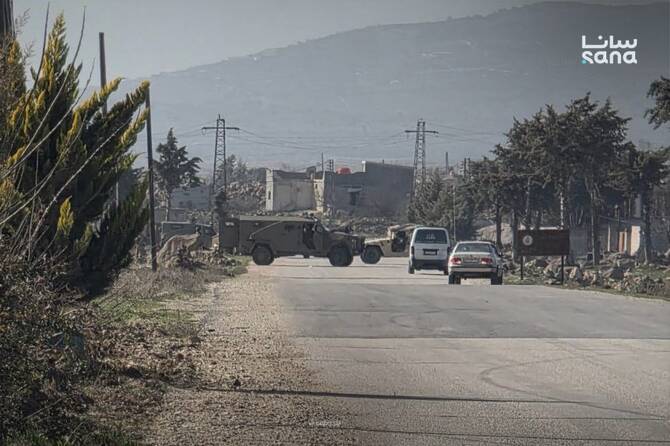
Israeli forces established temporary vehicle-search checkpoints in both Quneitra and Daraa governorates on 31 May, stopping and searching civilians before withdrawing from both locations without making arrests. Two Israeli military vehicles operated on the road linking Saida al-Golan and Quneitra, while a separate force of approximately 150 soldiers deployed to the eastern entrance of Maariya village in the Yarmouk Basin area of Daraa, searching vehicles and minibuses before pulling back. Syria has accused Israel of repeatedly breaching the 1974 Disengagement Agreement, which created the UN-patrolled buffer zone; Israel seized that entire zone in December 2024 following the fall of the Assad regime and has since conducted near-daily ground operations deeper into Quneitra and western Daraa. A UN-commissioned dataset documented 897 separate incidents in southern Syria attributed to Israeli activity through March 2026, with the monthly count rising rather than stabilising.
Key Judgments
The 31 May operations in Quneitra and Daraa are part of a deliberate, sustained Israeli military posture in southern Syria rather than isolated incidents. The SARI Global dataset documented 897 attributable incidents through March 2026, rising from 91 in January to 123 in March alone, and Antiwar.com and Enab Baladi have reported checkpoint operations in the same villages, on the same road segments, on at least three prior occasions in May. The pattern is systematic, not opportunistic.
The checkpoint-and-withdraw model serves an intelligence collection function alongside its coercive signalling purpose. Antiwar.com’s reporting from 13 May noted that Israeli forces have been recorded seizing land ownership records during raids on the same village of Maariya. The 31 May operations follow this pattern: civilian stops and vehicle searches generate identity data and movement pattern intelligence that builds a population registry, even when no arrests result.
Whether direct security talks between Damascus and Israel, reported by The Tahrir Institute and others as ongoing into early 2026, have produced any operational constraints on IDF checkpoint activity. The talks’ existence is credibly reported; their content and whether any red lines or understandings on civilian areas have been exchanged is not publicly known and cannot be assessed from open-source reporting alone.
2
Governorates Hit, 31 May
150
IDF Soldiers, Daraa Force
897
IDF Incidents, Southern Syria, to Mar 2026
0
Arrests, 31 May Operations
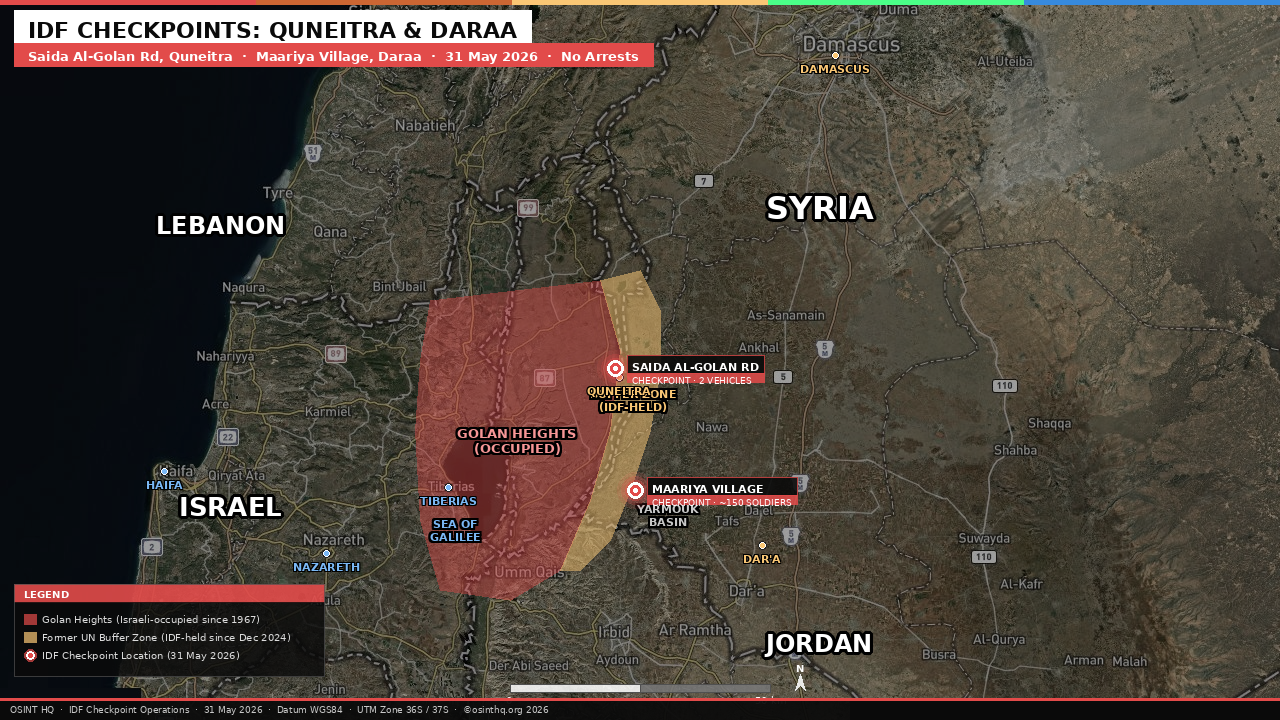
Southern Syria showing IDF checkpoint operations at Maariya village (Daraa) and the Saida al-Golan road (Quneitra) on 31 May 2026. The UN buffer zone, seized by Israel in December 2024, is indicated. Territory delineations approximate per SANA, SOHR, and Antiwar.com open-source reporting as of 31 May 2026. Map: OSINT HQ / OSINT. Datum WGS84, UTM Zone 36S. ©osinthq.org 2026
MGRS: 36S YB 62145 28609 32.7642°N 35.7983°E Eastern entrance to Maariya village, Yarmouk Basin. IDF force of approximately 150 soldiers and four vehicles. Checkpoint operated at dawn, searched vehicles and minibuses, no arrests. Village is in Israeli-controlled Daraa per Wikipedia 2026 status notation. Source: Wikipedia infobox coord (32.76417N, 35.79833E); corroborated by SANA and Antiwar.com reporting on Maariya as a recurring IDF operational site |
MGRS: 36S YB 60377 65836 33.1000°N 35.7900°E Approximate point on road between Saida al-Golan village and Quneitra city. Two IDF military vehicles, checkpoint established, passersby searched, troops withdrew. Exact kilometre mark not disclosed. Accuracy bound approximately 2 to 5 km. Source: Approximate per SANA and Arab News narrative description; Saida al-Golan village centroid used as reference point | ||||
MGRS: 36S YB 62847 67789 33.1170°N 35.8170°E Largely destroyed and abandoned capital of Quneitra Governorate. Within the former UN buffer zone. Now under Israeli control following December 2024 occupation of the Area of Separation. Reference point for MGRS grid orientation and route analysis. Source: Wikipedia infobox (33.117N, 35.817E) |
MGRS: 37S BS 28242 13065 32.6218°N 36.1037°E Capital of Daraa Governorate. Approximately 34 km east-southeast of Maariya village. Reference point for Daraa province grid orientation. Note: Daraa city sits in UTM Zone 37S; Maariya village sits in adjacent Zone 36S due to the 36 degree longitude boundary passing between them. Source: Wikipedia infobox (32.6218N, 36.1037E) |
SITREP Timeline : IDF Activity in Southern Syria, December 2024 to May 2026
🔴 The 31 May Operations
Two Checkpoints, Two Governorates, A Sunday Morning That Now Looks Like Routine
The Quneitra operation on 31 May involved two Israeli military vehicles advancing along the road linking Saida al-Golan village and the abandoned city of Quneitra, in the indicative grid area 36S YB 60377 65836. Syrian Arab News Agency reported that soldiers stopped and searched passersby before withdrawing. The location is directly inside the former UN Area of Separation, now under IDF control since December 2024. The same road, between Saida al-Golan and the Quneitra area, was used by IDF forces for an identical checkpoint operation recorded by Antiwar.com on 7 May and by Enab Baladi on 12 May, suggesting it is now part of a routine route.
Simultaneously in Daraa, a substantially larger force deployed to Maariya village. Municipality head Muwaffaq Mahmoud, speaking to SANA, said four military vehicles arrived on Sunday morning carrying approximately 150 soldiers. The force established a checkpoint near the telephone exchange at the eastern entrance to the village at grid 36S YB 62145 28609 (32.7642°N, 35.7983°E), in the Yarmouk Basin area. Mahmoud confirmed that pedestrians, private vehicles, and minibuses were searched and that the troops withdrew without making arrests or detaining anyone.
The telephone exchange as a checkpoint anchor is not incidental. Telephone infrastructure provides a natural pinch point on a village road and offers the force a fixed navigational reference. It is the same eastern entrance that Antiwar.com described as the site of a 13 May operation in which IDF troops briefly detained one local before releasing him. Maariya has now been reported as an IDF operational site on at least three confirmed occasions in May 2026 alone.
🟡 The Legal Frame
An Agreement Israel Says Has Collapsed, And A Buffer Zone It Now Occupies
The 1974 Disengagement Agreement between Israel and Syria ended the Yom Kippur War and created the Area of Separation, a demilitarised buffer zone on the Syrian side of the ceasefire line. The United Nations Disengagement Observer Force, UNDOF, has patrolled it since its creation. Israel occupied the Golan Heights during the 1967 war, annexed the Israeli-held portion in 1981 in a move not recognised by the international community, and used the buffer zone as a de facto border with Syrian-administered territory for five decades.
When the Assad government fell on 8 December 2024, Israeli Prime Minister Benjamin Netanyahu announced the disengagement agreement had “collapsed” and ordered the IDF to complete its takeover of the buffer zone. UNDOF identified at least ten IDF positions inside the zone within days. The UN secretary-general’s spokesman, Stephane Dujarric, stated directly that the IDF presence constituted a violation of the 1974 agreement. The Security Council nevertheless renewed UNDOF’s mandate unanimously in Resolution 2766 on 20 December, preserving the legal architecture of the agreement even as Israel moved to render it inoperative on the ground.
Syria’s position, reiterated in its statement on 31 May, is that the measures Israel has taken in southern Syria are null and void under international law and carry no legal effect. That position is consistent with the resolution adopted by the UN Human Rights Council in early 2026, which condemned settlement expansion, land confiscation, and practices the Council described as amounting to de facto annexation. The operative question is not whether a legal consensus exists against the Israeli posture; it does. The question is what enforcement capacity exists behind that consensus. The current answer, as evidenced by 897 documented incidents and a rising monthly count, is: none that has produced behavioural change.
🔵 The Operational Pattern
From Strike Activity to Coercive Security Structure: What 897 Incidents Actually Look Like on the Ground
The SARI Global dataset, published on the UN’s own website, uses specific language to describe what has evolved in southern Syria: a “coercive security structure” combining patrols, aerial surveillance, checkpoints, and movement restrictions. That framing distinguishes the current phase from the initial December 2024 takeover of the buffer zone, which was primarily a positional seizure. What has emerged since is a form of population administration: regular ground contact with civilians, vehicle searches, identity checks, land record collection, and the anchoring of that activity to fixed landmarks such as village eastern entrances and telephone exchanges.
The agricultural damage dimension, reported by Antiwar.com in early May, adds a further layer. Earthen fortifications being built in Quneitra villages are situated on farmland, damaging crops and access routes as a byproduct of their construction. Whether the damage is deliberate economic pressure or simply incidental to force protection engineering is not determinable from open-source reporting. Locals cited by both Antiwar.com and The New Arab use the language of permanence: they do not speak of an occupation that might end but of one that is deepening its infrastructure.
The prefabricated structures brought into Quneitra sites in April 2026, reported by The New Arab alongside resident accounts of what they interpreted as base-construction activity, point in the same direction. A checkpoint that requires no structure can be folded in ten minutes. Prefabricated accommodation means personnel staying longer than a patrol cycle. Locals in the area, speaking to multiple correspondents, said the regularity of the visits, combined with the physical infrastructure, left them fearing that villages historically just outside Israeli-administered territory were becoming a more or less permanent IDF operational zone.
⚠ Damascus, Damascus-Tel Aviv Talks, And The Syrian Government’s Position
Syria Has Called the Measures Null and Void. The New Government Has Also Been Talking to Israel Directly.
Syria’s post-Assad government under Hay’at Tahrir al-Sham and its affiliated institutions has adopted a formally adversarial public position toward the Israeli occupation of the buffer zone and the ongoing incursions. The statement repeated on 31 May, citing violations of the 1974 agreement and demanding Israeli withdrawal, is consistent with official Syrian government positions across the five months since Assad fell. At the same time, The Tahrir Institute for Middle East Policy reported in March 2026 that direct security discussions between Damascus and Israel did take place, focused on the possibility of reviving the disengagement agreement’s framework.
What those talks produced, if anything, is not publicly known. The 897-incident dataset and the 31 May checkpoint activity suggest that if operational constraints on IDF activity in Quneitra and Daraa were part of any understanding, they have not translated to ground-level behaviour. The Tahrir Institute’s assessment from March noted that the talks’ existence underlined that the south “remains unsettled rather than contained,” and that characterisation fits the current picture. The IDF is not fighting in Quneitra and Daraa; it is administering a contested zone while the diplomatic frame around that zone remains unresolved.
The UN Human Rights Council resolution adopted in the first quarter of 2026, which passed 34 to three with ten abstentions, reflects broad international rejection of the Israeli position. It called for an immediate halt to settlement expansion and condemned land confiscation, home demolitions, and population-transfer measures. The three opposing votes, and ten abstentions, suggest the coalition against Israeli actions in Syria is not uniform. The United States recognised the Golan Heights ceasefire line as Israel’s border with Syria in 2019 under the Trump administration, a position that has not been reversed and that structurally distinguishes Washington’s legal reading from that of most other UN members.
Muwaffaq Mahmoud, Head, Maariya and Abdeen Municipality : Statement to SANA, 31 May 2026
“Four Israeli military vehicles arrived in the area on Sunday morning carrying what he estimated to be around 150 soldiers. The force established a checkpoint near the telephone exchange at the eastern entrance to the village and searched people, vehicles and passing minibuses. There were no reports of arrests or detentions before the troops withdrew from the area.”
Source Reliability Matrix
NATO grading: REL A (reliable) to F (unreliable). CRED 1 (confirmed) to 6 (cannot judge).
CRED 2
Syrian state media. Interested party, institutional bias toward maximising IDF violation framing. Named municipal source (Mahmoud) adds credibility; incident corroborated by Arab News replication of same wire content.
CRED 2
Major regional English-language wire, Saudi-linked. Reliable secondary publication of the SANA primary report. Carries no independent sourcing but confirms the wire circulation.
CRED 2
Antiwar.com’s Syria coverage by Jason Ditz is primary sourced from SANA, SOHR, and local correspondents. Consistent, factual, and strong track record on southern Syria ground activity. Used here for pattern corroboration across May.
CRED 1
Published on the UN’s official documentation portal. 897-incident figure and monthly breakdown used for the stats dashboard and pattern analysis. Highest reliability for quantitative assessment of IDF operational tempo.
CRED 2
Independent Syrian media outlet with embedded Quneitra correspondent. On-the-ground sourcing for 12 May Khan Arnabeh checkpoint operation. Used for pattern corroboration of Saida al-Golan road as a recurring IDF route.
CRED 2
Policy analysis organisation with Syria specialisation. Used for strategic context on Damascus-Tel Aviv talks and the political environment in southern Syria post-Assad. Analytical framing, not raw intelligence.
OSINT HQ Assessment
Israel is not conducting sporadic incursions into southern Syria. It is constructing a coercive civil-military administration across Quneitra and western Daraa, and the 31 May operations are one data point in a trajectory that has accelerated every month since December 2024.
✓ What We Know
Two IDF checkpoint operations took place on 31 May 2026, in Quneitra (Saida al-Golan road, two vehicles) and Daraa (Maariya eastern entrance, approximately 150 soldiers). No arrests were made in either. SARI Global documented 897 IDF-attributed incidents in southern Syria through March 2026, rising from 91 per month in January to 123 in March. The same Maariya village eastern entrance was the site of a 13 May IDF raid in which a local was briefly detained. The same Saida al-Golan road was used for IDF operations on 7 May and 12 May. Israel seized the entire UN buffer zone in December 2024. Prefabricated structures have been brought into Quneitra sites, interpreted by residents as base construction. The IDF has been recording land ownership documents in Maariya.
? What We Do Not Know
Whether direct Damascus-Tel Aviv security talks produced any operational understandings on civilian zones in Quneitra and Daraa, and if so whether those understandings are now being violated. The IDF’s stated operational objective for the checkpoint-and-withdraw model: whether it is primarily intelligence collection, deterrence signalling, or preparation for further territorial consolidation. Whether the prefabricated structures in Quneitra represent forward operating base construction or temporary patrol support facilities. Whether the rising monthly incident count (91, 97, 123 per SARI Global) has continued to accelerate in April and May 2026.
☉ What To Watch
Whether the SARI Global or equivalent UN-commissioned dataset for April to May 2026 shows the monthly incident count continuing to rise, holding steady, or declining. Whether IDF operations extend from the Yarmouk Basin into additional Daraa subdistricts previously not reported as operational zones. Whether any arrest or detention during a checkpoint operation produces a detainee held for more than a few hours, which would signal a shift from intelligence-collection posture to administrative detention posture. Whether the Security Council takes any action at the UNDOF mandate renewal (due June 2025 cycle, next renewal thereafter). Whether Damascus publicly acknowledges or denies that security talks with Israel addressed the Quneitra and Daraa situation.
Sources
- Israeli forces set up temporary checkpoints in southern Syrian towns, Arab News, 31 May 2026
- Israeli occupation forces conduct incursions in Quneitra and Daraa provinces, SANA, 31 May 2026
- Israeli Troops Raid Villages in Southwest Syria, Detain Civilian, Antiwar.com, 13 May 2026
- Syrians Report Growing Agricultural Damage From Israeli Operations in Quneitra, Antiwar.com, 7 May 2026
- Israel Sets Up Checkpoint in Quneitra Countryside, Enab Baladi, 12 May 2026
- Syrians fear Israel building base after Quneitra incursions, The New Arab, 19 April 2026
- UN Reports Reveal Extent of Israeli Occupation Violations in Syria (SARI Global dataset), Levant24, April 2026
- After Assad, a New Uncertainty in Syria’s South, Tahrir Institute for Middle East Policy, March 2026
- UNDOF (Golan) June 2025 Monthly Forecast, Security Council Report, 2025
- What is the 1974 disengagement agreement between Syria and Israel, The National, 7 January 2026
- Maariya village Wikipedia infobox (coord source: 32.76417N, 35.79833E)
- Quneitra city Wikipedia infobox (coord source: 33.117N, 35.817E)
Editorial Verification
The 31 May checkpoint operations in Quneitra and Daraa are verified through Arab News (primary publication, 31 May 2026) and SANA English wire (31 May 2026), with the SANA report carrying a named primary source: Muwaffaq Mahmoud, head of the Maariya and Abdeen municipality. The Arab News account replicates the SANA wire; no independent second wire was identified by time of publication. Background pattern corroboration draws on Antiwar.com (13 May and 7 May 2026), Enab Baladi (12 May 2026), The New Arab (19 April 2026), SOHR (5 April 2026), and the SARI Global dataset published on the UN’s documentation platform. The 897-incident figure and monthly breakdown are sourced to SARI Global as reported by Levant24 in April 2026. The 1974 Disengagement Agreement background is sourced to The National (7 January 2026), Security Council Report UNDOF forecast (June 2025), and UN secretary-general spokesman statements cited by Times of Israel (December 2024). The Damascus-Tel Aviv talks reference is single-source to The Tahrir Institute for Middle East Policy (March 2026) and is flagged accordingly.
Coordinates and map (v8): Maariya village checkpoint location is PRECISE, sourced from Wikipedia infobox (32.76417N, 35.79833E), cross-confirmed by SANA and Antiwar.com narrative descriptions of the eastern village entrance. Quneitra city cross-check reference is PRECISE, sourced from Wikipedia infobox (33.117N, 35.817E). Saida al-Golan road checkpoint is INDICATIVE, plotted from Saida al-Golan village centroid per SANA narrative description of the road between Saida al-Golan and Quneitra; exact kilometre mark not disclosed, accuracy bound approximately 2 to 5 km. Daraa city provincial reference is PRECISE, sourced from Wikipedia infobox (32.6218N, 36.1037E). Static map produced with PIL overlay script sb-map-overlay.py on a satellite base image. Third-party watermarks removed from base before overlay. Territory fills and strike markers are approximate per open-source reporting. No classified imagery used. No third-party watermarks appear in the published image.
MGRS datum: WGS84 / UTM Zone: 36S (Quneitra and Maariya) / 37S (Daraa city reference) / Cross-check reference: Quneitra city 36S YB 62847 67789
All claims independently attributed and verified to open sources where possible.
Approved for Publication
Marcus V. Thorne
Lead Editor, OSINT HQ
©osinthq.org 2026
This article is for news and analysis purposes only. Based on publicly available news sources and military updates. All rights reserved. Not for commercial reuse without permission.