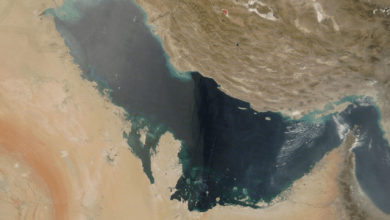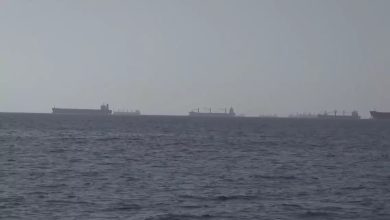
British Navy Stages Mine-Clearing Force in Gibraltar, Waits for US-Iran Peace Deal
Threat Level Assessment
LEVEL 4 OF 5, SERIOUS
Bottom Line Up Front
Hundreds of British sailors aboard the RFA Lyme Bay are staged in the British Overseas Territory of Gibraltar, loading ammunition and mine-hunting autonomous sea drones, awaiting orders to sail for the Strait of Hormuz as part of a UK-France-led international mine clearance coalition. The mission will not begin until a US-Iran peace agreement is finalised; Trump said on 24 May that a deal has been "largely negotiated" but final terms are not yet settled. Armed Forces Minister Al Carns confirmed at least 6,000 ships have been prevented from transiting the strait since the conflict began on 28 February. Clearing a single transit lane is the immediate priority; clearing the entire strait could take months or years.
Key Judgments
The UK has assembled a credible, deployable mine countermeasures capability. The combination of RFA Lyme Bay as a mother ship, HMS Dragon for air support, autonomous sonar sea drones, and remotely operated mine-disposal vehicles represents a serious operational package. The visit to RFA Lyme Bay was an organised press access event, not a speculative briefing; the ship was actively loading ammunition during the access.
The press access event is partly strategic signalling toward Washington. Carns explicitly acknowledged the question of whether the operation is partly for show, and did not dismiss it. The UK has strong institutional reasons to demonstrate value to the United States at a moment when Trump has publicly belittled British naval capability and Prime Minister Starmer. Demonstrating a ready force in Gibraltar costs little and earns diplomatic capital regardless of whether deployment follows.
Whether actual mines are present in the strait in meaningful numbers. A US official told the AP on background that no mines have been found or destroyed, and no ships have been damaged by mines; commercial traffic has continued at reduced volume. The strait's closure appears to rest substantially on insurance and commercial risk calculation rather than confirmed mined lanes. Whether the UK's clearance operation will encounter a significant minefield, or a notional one, is operationally material.
6,000+
Ships Blocked Since 28 Feb
700
Ships Awaiting Transit, Priority Lane
40
Nations in UK-Led Coalition
0
Mines Confirmed Found or Destroyed
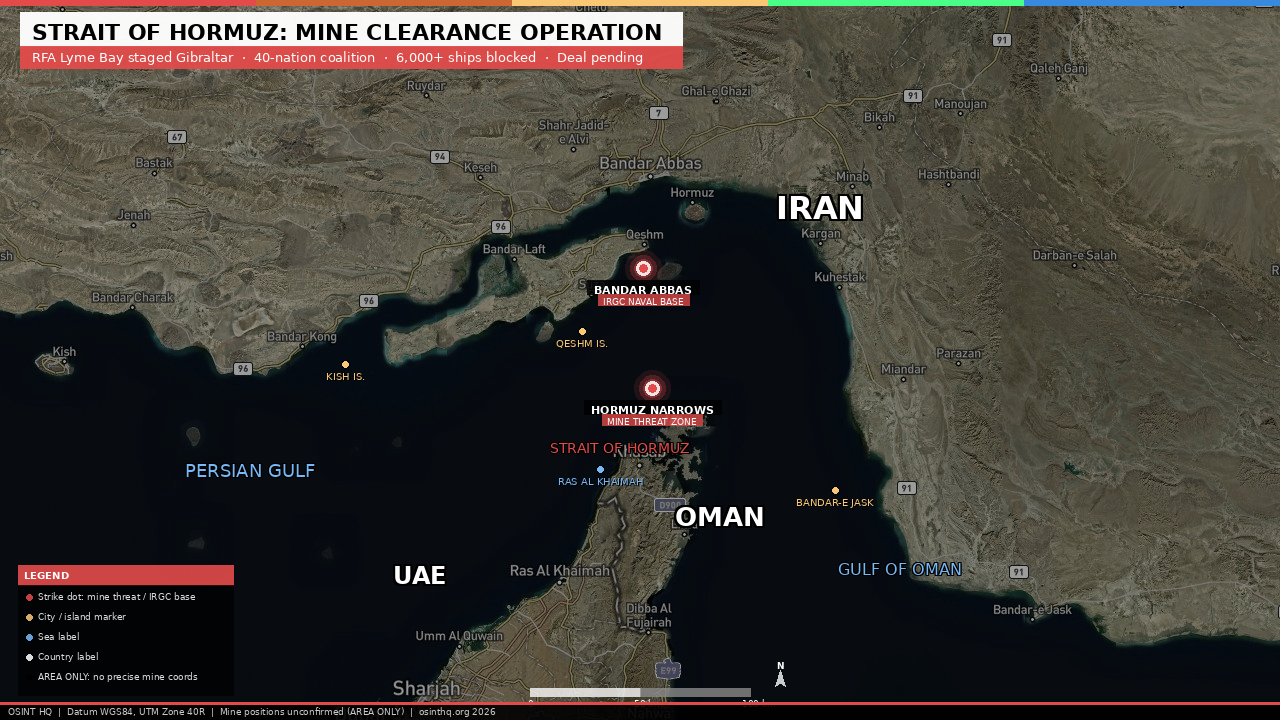
Strait of Hormuz operational theatre. Staging area: Gibraltar (30S TF). Transit route: Suez Canal. Operational area: Hormuz narrows (40R DQ). Mine presence unconfirmed; strait plotted as AREA ONLY. Map: OSINT HQ / OSINT. Datum WGS84, UTM Zone 40R. ©osinthq.org 2026
📍 Gibraltar Harbour, Staging Area
PRECISEMGRS: 30S TF 88583 03144
36.1500°N 5.3500°W
British Overseas Territory of Gibraltar. RFA Lyme Bay docked and loading ammunition and mine-hunting autonomous sea drones. Press access confirmed 22 May 2026.
Source: Wikipedia infobox (Gibraltar Harbour 36°09'N 5°20'W) / GeoNames
📍 Strait of Hormuz, Operational Area
AREA ONLYApproximate Area
Centre of indicative zone. Mine positions not publicly disclosed.
Iranian minelaying operations have not been confirmed by US military sources. No specific mine positions have been publicly disclosed. Strait plotted as approximate operational area only.
Source: Approximate per AP wire; mine locations undisclosed and unconfirmed
📍 Hormuz Narrows, Key Chokepoint
PRECISEMGRS: 40R DQ 35142 14608
26.3500°N 56.3500°E
Narrowest navigable passage of the Strait of Hormuz, approximately 33 nautical miles wide at the chokepoint. Primary mine threat zone per Cmdr. Britton's assessment of potential mine types.
Source: Wikipedia infobox (Strait of Hormuz)
📍 Suez Canal, Transit Waypoint
INDICATIVEMGRS: 36R VU 29567 83862
30.5852°N 32.2654°E
Canal midpoint, indicative transit waypoint. RFA Lyme Bay will transit south to north in reverse prior to reaching the Arabian Gulf. Accuracy bound approx. 20km along canal axis.
Source: GeoNames canal centroid
SITREP Timeline : Hormuz Closure and Mine Clearance Preparation, Feb to May 2026
🔵 The Ship and the Mission
RFA Lyme Bay: Mother Ship, Mine-Hunter, and Waiting Room for a Peace Deal That Is Not Yet Signed
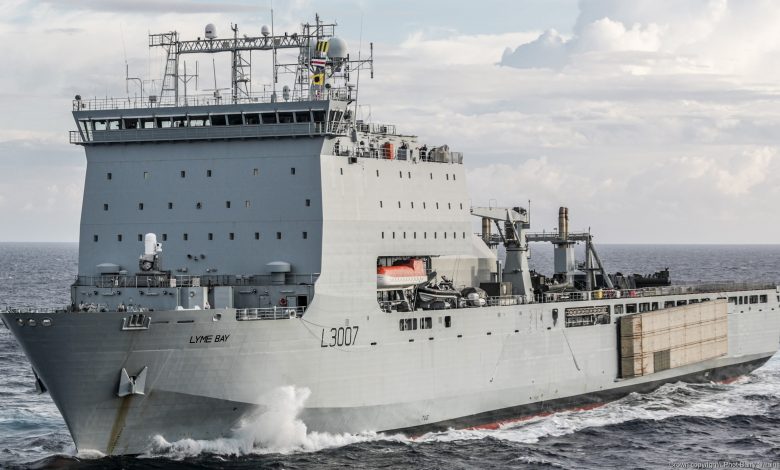
In the British Overseas Territory of Gibraltar, at approximately grid reference 30S TF 88583 03144 (36.1500°N, 5.3500°W), the Royal Fleet Auxiliary vessel Lyme Bay sits loaded and ready at the Mediterranean gateway. Hundreds of British sailors were aboard when AP journalists were escorted onto the ship on 22 May by Armed Forces Minister Al Carns. The amphibious landing ship was being loaded with ammunition. On the deck and in its hold were mine-hunting autonomous sea drones fitted with sonar, systems capable of scanning the seabed in roughly half the time a crewed vessel would require.
The RFA Lyme Bay's design makes it suited to this particular role. It acts as a mother ship: the autonomous sonar systems can be deployed from a smaller vessel launched from RFA Lyme Bay itself, allowing the mother ship to remain outside any potential minefield while its unmanned assets operate inside. Cmdr. Gemma Britton, who commands the Royal Navy's Mine and Threat Exploitation Group, described the operational sequence to AP: once a mine is located acoustically and visually, the standard approach is to send a diver with explosives who places a charge and detonates it from a safe distance. RFA Lyme Bay is also trialling a remotely operated vehicle that dives, places a charge, and sets it off without any diver in the water.
The deployment plan is set. RFA Lyme Bay will depart Gibraltar to rendezvous with the UK destroyer HMS Dragon and allied vessels providing air support, before the combined force transits the Suez Canal and enters the Persian Gulf. The operational objective, as stated by Britton, is first to clear a transit lane in the strait to allow approximately 700 ships to pass through; once that lane is open, a return lane will be cleared, allowing inbound traffic to resume. The strait as a whole, she said, could take months or years to fully clear.
🔴 The Mine Question
A Huge Potential Minefield, Zero Confirmed Mines: The Gap Between Operational Planning and What the US Has Actually Found
Cmdr. Britton told AP that Iran could have a "huge" variety of mine types deployed in the strait: rocket-propelled, cabled, bottom-laid mines triggered by sound, movement, or light. That is an honest characterisation of Iranian mine doctrine and inventory, which is well-documented in public military assessments and has been a source of concern for US naval planners since at least the 1980s tanker war. Iran's mine stockpile is real and its mine-laying capability is not in question.
What remains contested, per a US official who spoke to AP on background anonymity, is whether that capability has been exercised at scale in the current conflict. The official stated that the US has not found or destroyed any mines in the strait, nor have any ships been damaged by mines since the conflict opened on 28 February. Commercial traffic has, in the US official's framing, quietly continued at a much-reduced volume. Carns acknowledged when pressed by AP that some mines may have been detonated or drifted away but said that insurance companies require "absolute certainty" before they will certify the waterway as safe for commercial vessels. That insurance calculation, not a confirmed mined lane, appears to be the principal mechanism sustaining the closure.
The distinction matters for the operation's scope and duration. Clearing a strait that has been heavily mined with bottom-laid contact and influence mines is a major, months-long effort. Certifying a strait where mines may be absent or sporadic to a standard sufficient for insurers requires a thorough survey operation, but is a different proposition. RFA Lyme Bay's sonar drone complement is suited to both tasks; the political question is whether the mission's objective is the first, the second, or something in between.
Al Carns, Armed Forces Minister : Responding to AP Aboard RFA Lyme Bay, 22 May 2026
"Which other country can pull together 40 nations and come up with a solution to deal with a complex problem that we couldn't predict because we weren't involved?"
🟡 The Diplomatic Gate
The Operation Is Ready. Trump Says the Deal Is "Largely Negotiated." The Strait Remains Closed Until Both Statements Resolve Into One.
The British position is clear and was stated plainly by Carns: the international mine clearance operation will not begin until hostilities between the United States and Iran are formally concluded. RFA Lyme Bay will not enter the strait while active conflict is possible. That is standard mine countermeasures doctrine; sending sweeper and clearance vessels into a waterway where the adversary can lay additional mines, or fire on the sweeping force, is not a viable operation. The peace deal is therefore not merely a political precondition but an operational one.
Trump's 24 May social media post stated that final aspects and details of a deal were "currently being discussed" and would be "announced shortly." That framing is not new; senior US and Iranian officials have described a deal as close on multiple occasions since the 8 April ceasefire, and the Islamabad round of talks in April collapsed without agreement after 21 hours of negotiations. Carns told AP directly: "We don't know when the Americans, Iranians and Israelis are going to come up with a suitable solution." In the meantime, the crew will be "really, really ready."
The coalition's scale is notable. Carns described 40 nations participating, a number that reflects the breadth of countries with economic stakes in Hormuz transit. The strait is the transit point for roughly 20 percent of global oil trade and a significant share of liquefied natural gas exports; every major energy-importing economy has an interest in its reopening. Whether 40 nations translates to 40 operational contributions, or to political endorsement with a much smaller set of active participants, was not specified in the AP reporting.
⚠ The UK-US Dynamic
Trump Called the Royal Navy "Toys." Carns Is Showing Him a Ship Full of Autonomous Mine-Hunters.
The AP press access event on 22 May did not take place in a diplomatic vacuum. Trump has publicly and repeatedly denigrated British military capability: in March he described the Royal Navy as "toys" and called Prime Minister Starmer "not Winston Churchill," remarks that created significant friction in the UK-US relationship. The decision to invite journalists aboard RFA Lyme Bay, during active loading operations, is a direct counter-signal. It demonstrates a ready vessel, advanced autonomous systems, and a named multinational coalition, all at a moment when Washington is asking its allies to take on more of the strait burden.
When AP put to Carns the question of whether the British effort was partly for show, he did not deny it. He acknowledged that some mines had probably already been neutralised by natural drift or detonation, but said that acknowledgement was irrelevant to the commercial shipping problem: insurers require certified certainty, and only a formal survey and clearance operation provides that. "That's what this capability will provide," he said. The answer doubled simultaneously as a justification for the operational necessity and as a rebuttal of the "toys" characterisation.
The UK's positioning also reflects a structural calculation about the post-war order in the Gulf. Whoever leads the mine clearance coalition earns a significant role in the subsequent security architecture of the strait. France is the named co-lead; the US, which does not appear to have found mines itself, is nominally the country whose war created the problem. British leadership of a 40-nation humanitarian-economic reopening operation carries diplomatic weight that is distinct from, and potentially more durable than, the warfighting contribution Trump has been demanding.
Source Reliability Matrix
NATO grading: REL A (reliable) to F (unreliable). CRED 1 (confirmed) to 6 (cannot judge).
First-hand access reporting aboard RFA Lyme Bay. Named journalist, named minister, named commander, named vessel, confirmed location. Carried by ABC News, Washington Post, The Hill, Military.com, Fortune, CP24, Washington Times.
On-record ministerial statements made to international press. Verified against Wikipedia and UK MoD records confirming Carns as Armed Forces Minister since September 2025. Note: Daily Beirut (primary referral) incorrectly attributed statements to "Alok Sharma"; corrected to Al Carns per AP wire.
Named Royal Navy officer, Mine and Threat Exploitation Group commander. Technical briefing on mine types, autonomous systems, and clearance sequencing. On record to AP.
Single anonymous US official speaking on condition of anonymity on sensitive military matters. States no mines found or destroyed, no ships damaged. Flagged as single-source; not independently corroborated at time of publication.
Confirmed primary Trump post. Verified across AP wire. Assessment caveat: Trump has previously described Iran deal talks as close or agreed on multiple occasions without finalisation.
OSINT HQ Assessment
The RFA Lyme Bay press event is doing two things at once: signalling readiness to Washington and positioning the UK as the indispensable actor in the post-war Hormuz order. Whether it deploys depends on a peace deal that has been "close" before.
✓ What We Know
RFA Lyme Bay is in Gibraltar, loaded, and confirmed ready to depart for the Strait of Hormuz. The UK has assembled a 40-nation coalition co-led with France. Autonomous sonar drones and an ROV mine disposal system are aboard. HMS Dragon will provide air support. The operational objective is to clear a transit lane for approximately 700 ships first, then a return lane; full strait clearance could take months or years. The mission will not begin until a US-Iran peace agreement is concluded. Trump says a deal is "largely negotiated" as of 24 May. At least 6,000 ships have been blocked from the strait since 28 February.
? What We Do Not Know
Whether any mines are actually present in the strait in tactically significant numbers: a single anonymous US official told AP that no mines have been found or destroyed and no ships have been damaged. The scale of France's contribution and the specific operational roles of the other 38 coalition nations. The timeline for a signed US-Iran agreement, which has been described as close or "largely agreed" on multiple prior occasions without conclusion. Whether RFA Lyme Bay's departure is days or weeks away once an agreement is reached.
☉ What To Watch
Whether Trump's "largely negotiated" language on 24 May translates into a signed agreement in the coming days. Whether RFA Lyme Bay departs Gibraltar: any sailing announcement will be the clearest indicator that an agreement has been reached or is imminent. Whether the US publicly confirms or denies mine presence in the strait as a deal nears; US confirmation of mines would significantly change the scope and urgency of the clearance operation. Whether the UK-France co-lead arrangement gives London a durable seat in post-war Gulf security architecture regardless of the operation's mine count outcome.
Sources
- AP wire via ABC News: Britain's navy prepares to clear mines in the Strait of Hormuz while waiting for a peace deal, Emma Burrows, 23 May 2026
- AP wire via The Hill: Britain's navy prepares to clear mines in the Strait of Hormuz while waiting for a peace deal, 24 May 2026
- AP wire via US News: Britain's Navy Prepares to Clear Mines in the Strait of Hormuz While Waiting for a Peace Deal, 23 May 2026
- Daily Beirut: British Navy Prepares for Mine Clearance Mission in Strait of Hormuz, 25 May 2026 (note: minister misidentified as Alok Sharma; correct attribution is Al Carns per AP wire)
- Wikipedia: Al Carns, Armed Forces Minister (Parliamentary Under-Secretary of State for the Armed Forces, from 6 September 2025)
Editorial Verification
Primary source is AP wire filed 23 May 2026 by Emma Burrows from aboard RFA Lyme Bay, British Overseas Territory of Gibraltar, verified across seven independent syndication outlets (ABC News, The Hill, US News, Washington Post, Washington Times, Military.com, Fortune). All Carns and Britton statements are on record. The US official statement on the absence of confirmed mines is single-source (anonymous background); this is flagged in the Source Reliability Matrix and in Key Judgment 03. The Daily Beirut referral article incorrectly names the Armed Forces Minister as "Alok Sharma"; this is an error. The correct minister is Al Carns (Alistair Carns, Parliamentary Under-Secretary of State for the Armed Forces since 6 September 2025), confirmed by AP wire, Wikipedia, and UK Defence Journal reporting. No text in this article uses the erroneous name.
Coordinates and map (v8): Gibraltar Harbour (30S TF 88583 03144) is PRECISE, sourced from Wikipedia infobox (36°09'N, 5°20'W) and GeoNames. Hormuz Narrows (40R DQ 35142 14608) is PRECISE, sourced from Wikipedia infobox for the Strait of Hormuz. Suez Canal midpoint (36R VU 29567 83862) is INDICATIVE, sourced from GeoNames canal centroid. Strait of Hormuz operational area is AREA ONLY: no mine positions have been publicly disclosed by any party, and a US official has stated no mines have been confirmed found. No MGRS is shown for the AREA ONLY zone. Static map produced with PIL overlay script sb-map-overlay.py on a satellite base image. Third-party watermarks removed from base before overlay. Territory fills, route lines, and area markers are approximate per open-source reporting. No classified imagery used. No third-party watermarks appear in the published image.
MGRS datum: WGS84 / UTM Zone: 40R (Hormuz theatre) / 30S (Gibraltar) / Cross-check reference: Gibraltar Harbour 30S TF 88583 03144
All claims independently attributed and verified to open sources where possible.
Approved for Publication
Marcus V. Thorne
Lead Editor, OSINT HQ
©osinthq.org 2026
This article is for news and analysis purposes only. Based on publicly available news sources and military updates. All rights reserved. Not for commercial reuse without permission.