CENTCOM Strikes Iran Missile Sites and Mine-Laying Boats Near Bandar Abbas as Doha Talks Open
Threat Level Assessment
LEVEL 4 OF 5, SERIOUS
Bottom Line Up Front
US Central Command conducted airstrikes against missile launch sites and Iranian fast boats attempting to emplace naval mines in the area of Bandar Abbas on Monday 25 May, calling the operation self-defense under an ongoing ceasefire. Iranian state television reported multiple explosions near the city; Tabnak, described by the AP as close to former IRGC chief Mohsen Rezaei, reported four Revolutionary Guard troops killed on the boats, a claim that is single-source and unconfirmed. The strikes occurred simultaneously with the arrival of Iranian negotiators in Doha for talks aimed at finalising a peace deal, producing the most acute test yet of the 8 April ceasefire framework. Secretary of State Marco Rubio, speaking from India, said a deal could come within days while insisting the Strait of Hormuz would reopen one way or the other.
Key Judgments
The strikes occurred and targeted the stated categories of assets. CENTCOM's public statement from Capt. Tim Hawkins, confirmed to multiple wire services and corroborated by Iranian state television reporting explosions near Bandar Abbas, is not in dispute. The simultaneous timing with the Doha talks is not coincidental; it represents a coercive signalling operation packaged as a defensive necessity, communicating to Tehran that the United States will act inside the ceasefire window if it judges Iranian activity to pose a direct threat to its forces.
The ceasefire framework will survive this episode in its formal structure but its operational content is now effectively hollow. Both sides have conducted lethal or potentially lethal actions inside the ceasefire window: Iran through sustained mine-laying and drone activity, the United States through this and prior self-defense strikes. The Doha track appears to be absorbing these incidents as background conditions rather than deal-breaking violations, at least for now, because both sides still judge a negotiated outcome to be preferable to resumed full-scale war.
Whether the four IRGC deaths reported by Tabnak are accurate. That figure is single-source from a website with editorial proximity to IRGC political circles, and has not been confirmed by CENTCOM, Iranian state television, or any independent wire service at time of writing. The number may be accurate, may be inflated for political purposes, or may reflect a deliberate leak designed to signal Iranian losses without requiring official acknowledgment from Tehran.
2+
Iranian Vessels Targeted
48
Days Since 8 Apr Ceasefire
88
Days of War Since 28 Feb
4 ⚠
IRGC Dead, Tabnak (Single-Source)
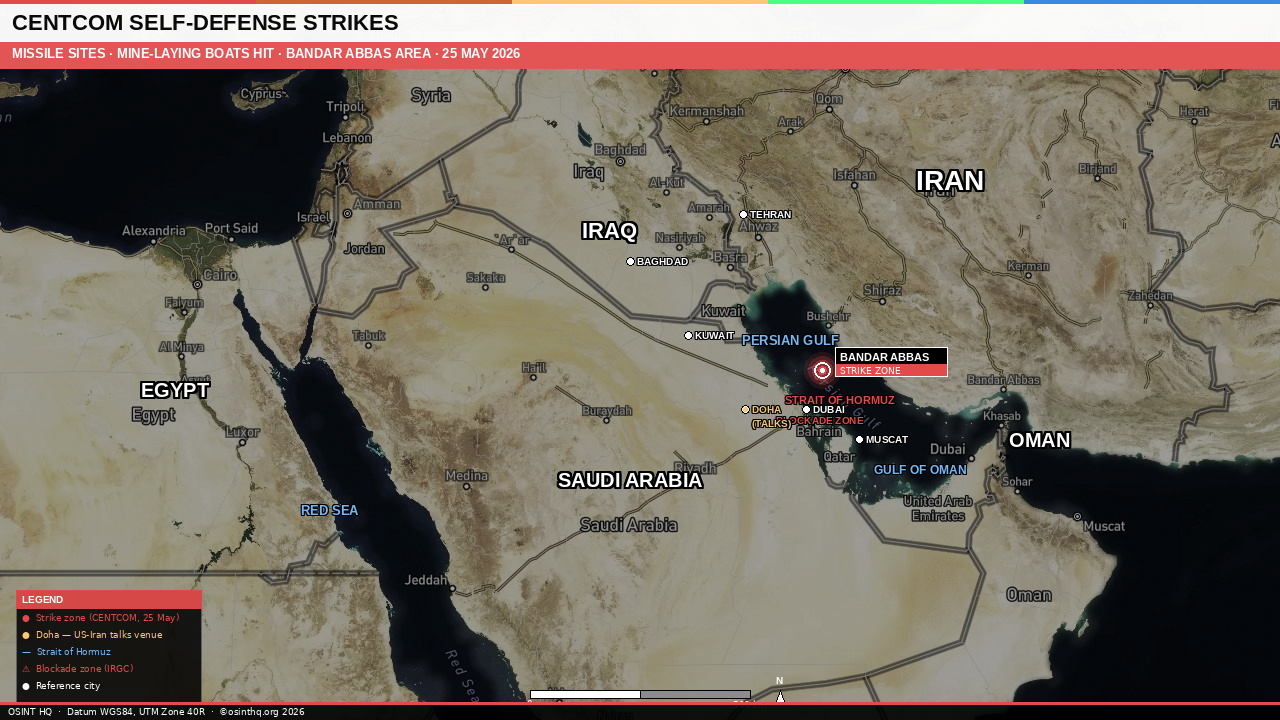
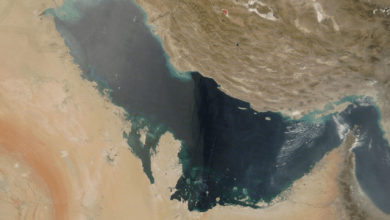
Strait of Hormuz theatre showing Bandar Abbas naval base area, CENTCOM self-defense strike zone (AREA ONLY), and the broader Hormuz blockade geometry. Territory fills and markers approximate per open-source reporting as of 26 May 2026. Map: OSINT HQ / OSINT. Datum WGS84, UTM Zone 40R. ©osinthq.org 2026
📍 Bandar Abbas City Centre, Reference
PRECISEMGRS: 40R DR 29458 08356
27.1961°N 56.2878°E
Capital of Hormozgan Province, location of Iran's main naval base. CENTCOM confirmed strikes in this general area. Cross-check reference for grid orientation.
Source: Wikipedia infobox, Bandar Abbas article. Cross-checked GeoNames.
📍 CENTCOM Strike Zone, Bandar Abbas Area
AREA ONLYApproximate Area
Centre of indicative zone. Exact site not publicly disclosed.
CENTCOM stated strikes were in the area of Bandar Abbas. Exact maritime and land coordinates of missile sites and boat locations were not disclosed in the official statement.
Source: Approximate per CENTCOM statement, Capt. Tim Hawkins, 25 May 2026
📍 Strait of Hormuz Midpoint, Reference
INDICATIVEMGRS: 40R DQ 25293 36813
26.5500°N 56.2500°E
Standard navigational midpoint for the Strait of Hormuz narrows. Approximately 40km south-southwest of Bandar Abbas. Iran's blockade zone spans the wider shipping lane.
Source: Standard navigation reference. OSINT HQ map coordinate library.
📍 Doha, Qatar (Talks Venue)
PRECISEMGRS: 39R WH 53459 96656
25.2854°N 51.5310°E
Capital of Qatar and venue for the latest US-Iran negotiations. Iranian negotiating team arrived as strikes were conducted, per Reuters and Al Jazeera.
Source: Wikipedia infobox, Doha article. Cross-checked GeoNames.
SITREP Timeline : US-Iran Ceasefire Period, April to May 2026
🔴 The Strikes
Missile Sites and Mine-Laying Boats: What CENTCOM Said and What It Did Not
US forces struck targets in the area of Bandar Abbas on Monday 25 May in what US Central Command characterised as self-defense operations conducted while the ceasefire with Iran remained formally in effect. The CENTCOM statement, delivered by spokesperson Capt. Tim Hawkins and confirmed to multiple wire services including AP, Fox News, and Al Jazeera, identified two target categories: missile launch sites and Iranian boats attempting to emplace naval mines. CENTCOM confirmed the strikes took place in the area of Bandar Abbas (MGRS reference: 40R DR 29458 08356), where Iran's main naval base is located adjacent to the Strait of Hormuz. Precise strike coordinates were not disclosed, and the strike zone is treated as AREA ONLY throughout this report.
Iranian state television, IRIB, reported multiple explosions near Bandar Abbas around midnight local time on Monday. The Tabnak news website, which the Associated Press described as close to former IRGC chief Mohsen Rezaei, reported that four Revolutionary Guard troops were killed in the strikes on the boats. That claim is unconfirmed by any independent wire service, by CENTCOM, or by Iranian state television at time of writing, and is treated throughout this report as single-source. A US official separately stated that the operations were defensive in nature and did not signal the collapse of the ceasefire with Iran.
OSINT social media accounts documented air defense activity in the Bandar Abbas area in the hours surrounding the strikes, consistent with the CENTCOM account of active Iranian military operations in the vicinity. Iran's southeastern air defense command also claimed, separately, to have downed what it described as an Israeli Orbiter reconnaissance drone over Hormozgan Province on the same day; the IDF stated it was not familiar with that incident. Whether the reconnaissance drone was operating in connection with the strike package or conducting an independent collection sortie remains unknown.
🟡 The Diplomatic Envelope
Kinetics and Diplomacy Running Simultaneously: The Doha Track Absorbs Another Shock
The timing of the strikes was not incidental. Iranian negotiators were arriving in Doha, Qatar (39R WH 53459 96656), for a new round of talks aimed at concluding the 88-day-old war at the moment CENTCOM was conducting the operation. Reuters, citing an official briefed on the Iranian delegation's Doha visit, reported that discussions were focused on the Strait of Hormuz and Iran's stockpile of highly enriched uranium, with Iran's central bank governor also in attendance to discuss the potential release of frozen Iranian funds as part of a final deal.
Secretary of State Marco Rubio, speaking to reporters aboard his plane in Jaipur at the conclusion of a four-day visit to India, maintained that a deal remained achievable within days. He described the strikes as defensive and said the Strait of Hormuz had to be open, using language verified against The Irish Times: the straits are going to be open one way or the other, so they need to be open. The Al Jazeera analyst quoted by that outlet characterised the Bandar Abbas strikes as something to watch but stopped short of declaring the diplomatic process derailed, suggesting the operational and strategic tracks are deliberately being kept separate by both parties.
Iran's Foreign Ministry spokesperson Esmaeil Baqaei acknowledged that both sides had reached conclusions on a large portion of the outstanding issues but cautioned that an agreement was not yet imminent. The Doha round's central sticking points remain the scope of Hormuz access, the disposal of Iran's enriched uranium, and whether any preliminary deal must include a cessation of hostilities in Lebanon, which Tehran has insisted upon and which Israel has resisted.
CENTCOM Spokesperson Capt. Tim Hawkins : Official Statement, 25 May 2026
"U.S. forces conducted self-defense strikes in southern Iran today to protect our troops from threats posed by Iranian forces. Targets included missile launch sites and Iranian boats attempting to emplace mines. U.S. Central Command continues to defend our forces while using restraint during the ongoing ceasefire."
🔵 The Nuclear File
Trump Modifies Uranium Demand: Destruction In Place Now On the Table Alongside Transfer
On 26 May, President Trump posted on social media modifying one of the core conditions he had repeatedly stated for an Iran deal. He said Iran's enriched uranium, which he called nuclear dust, must either be immediately turned over to the United States or, preferably, destroyed in place at another acceptable location under the supervision of what he called the Atomic Energy Commission or its equivalent, with that body serving as witness to the process. The post represents a softening from his earlier position, which had consistently demanded physical transfer of the material to US custody.
AFP noted that the Atomic Energy Commission Trump referenced was abolished in 1974 and its functions divided between the Nuclear Regulatory Commission and the Department of Energy, suggesting Trump was likely referring to the International Atomic Energy Agency. The reference is consistent with the IAEA's standard safeguards and verification role. Iran has publicly and repeatedly stated it will not export its enriched uranium under any deal. Whether destruction in place under international supervision represents a genuine split-the-difference position or a public reframe of an already-agreed private arrangement is not determinable from open sources at time of publication.
A Reuters source briefed on the Doha talks indicated that the uranium disposal question and Hormuz access timelines were the two dominant agenda items for the Iranian delegation, with the central bank governor's attendance signalling that a financial package covering sanctions relief and frozen asset releases was being structured simultaneously. The technical complexity of uranium disposal, whether by export or verified in-place destruction, means this file will not be resolved in a single Doha session regardless of political will on either side.
⚠ The Lebanon Complication and the Abraham Accords Demand
Netanyahu Escalates; Tehran Holds the Lebanon Linkage; Trump Adds a New Regional Condition
Israeli Prime Minister Benjamin Netanyahu ordered an acceleration of the Lebanon offensive on Monday 25 May, vowing to crush Hezbollah following drone attacks on Israeli forces, per Al Arabiya English. Netanyahu has maintained throughout the ceasefire period that any final agreement must eliminate the nuclear threat entirely, language that mirrors the Trump administration's rhetoric but structurally complicates the Doha track. Israel is not a formal party to the US-Iran negotiations but exercises deep leverage over their outcome through its military posture in Lebanon and its capacity to take unilateral action against Iranian assets.
Iran has insisted throughout the ceasefire period that any deal must encompass a cessation of hostilities in southern Lebanon and must not leave Hezbollah exposed to continued Israeli military operations. The United States has described the status quo with Hezbollah as untenable but has sought to decouple the Lebanon file from the bilateral Iran-US track. Tehran has refused that decoupling. A renewed Israeli escalation in Lebanon during an active Doha talks round adds pressure to the Iranian negotiating team's domestic position and narrows the political space available to those inside Iran who favour a deal.
Trump has also stated publicly that he considers it mandatory for Saudi Arabia, Qatar, Turkey, and Pakistan to normalise relations with Israel as part of any broader regional settlement. Anna Jacobs of the Arab Gulf States Institute in Washington told AFP that Gulf states were unlikely to accept such maximalist conditions, noting that normalisation remained contingent on the unresolved question of Palestinian statehood, a condition maintained by both Riyadh and Doha. These demands are not peripheral to the negotiation; they represent the outer boundary of what a comprehensive settlement would require and explain why the gap between a preliminary ceasefire extension and a comprehensive deal remains structurally large.
🟢 Energy Markets
WTI Drops More Than Five Percent; Brent Rises: The Market's Split Read on Ceasefire Durability
Oil markets responded to the 25 May strikes with divergent moves that reflect the ambiguity inherent in the current situation. By Tuesday morning, West Texas Intermediate fell more than five percent while Brent crude moved upward. The divergence between the two benchmarks reflects differing near-term supply reads. WTI's decline suggests some market participants are pricing in eventual Hormuz reopening following the strikes on mine-laying capability; Brent's rise reflects the risk premium European and Asian buyers place on continued uncertainty over the straits' status.
The Iranian blockade of the Strait of Hormuz, which passes roughly 20 to 30 percent of global seaborne oil and a substantial share of liquefied natural gas, has been in effect in various forms since the war opened on 28 February. The Persian Gulf Strait Authority, created by Iran after the war began, published a formal claim to a controlled maritime zone spanning the Strait on 20 May, a claim the United States has called unlawful. CENTCOM's strikes on mine-laying boats are directly connected to that blockade: they are an attempt to prevent Iran from embedding a physical denial capability in the seabed rather than depending entirely on patrol-boat enforcement of the closure. Whether Monday's strikes successfully degraded Iran's near-term mine-laying capacity is unknown from open sources.
Source Reliability Matrix
NATO grading: REL A (reliable) to F (unreliable). CRED 1 (confirmed) to 6 (cannot judge).
Primary US government source. Confirmed verbatim across AP, KVIA/ABC, Fox News, Al Jazeera, and The Irish Times.
Primary wire. Bylined reporting with named CENTCOM source and independent contextualisation of the Tabnak casualty claim.
Official briefed on the Doha talks, background sourcing. Reliable for diplomatic track context.
Single-source. AP characterises Tabnak as close to former IRGC chief Rezaei. Casualty claim unconfirmed by any independent wire. Flagged purple throughout.
Established international news outlets. Rubio statements, oil market data, and diplomatic commentary sourced from these three outlets and cross-verified.
OSINT HQ Assessment
The ceasefire between the United States and Iran is now operating as a framework in name only. Both parties are conducting kinetic operations inside its window while simultaneously negotiating in Doha. The question is whether the Doha track can absorb enough of these shocks before one breaks it entirely.
✓ What We Know
CENTCOM struck missile launch sites and Iranian mine-laying boats in the area of Bandar Abbas on 25 May. IRIB confirmed explosions near the city. Rubio told reporters from India that the deal could come within days and the Strait must open one way or the other. Iranian negotiators were in Doha simultaneously. Trump modified his uranium demand to include destruction in place under IAEA supervision. Netanyahu ordered Lebanon offensive acceleration. Oil markets split: WTI down more than five percent, Brent up. A US official stated the operations did not signal ceasefire collapse.
? What We Do Not Know
Whether the four IRGC casualties reported by Tabnak are accurate. The precise coordinates and nature of the targeted missile sites and boat positions. The current status of the Doha talks as of publication: whether the strikes triggered a diplomatic walkout or were absorbed. Whether Trump's uranium modification reflects a genuine concession or a reframe of a privately agreed position. How the IRGC is interpreting the strikes internally, given the known divide between the Guard and Iran's negotiating team. Whether Iran's mine-laying capability near Bandar Abbas was materially degraded.
☉ What To Watch
Whether Iran's delegation remains in Doha or withdraws. Whether Tehran issues a formal denunciation that moves toward ceasefire collapse, or absorbs the strikes as a necessary cost of the negotiation environment. Whether CENTCOM conducts further self-defense operations within 48 hours, indicating the mine-laying threat was not fully neutralised. Whether Rubio's days formulation produces a framework agreement before the ceasefire structure erodes further. Whether the Lebanon front escalates to a point that breaks Iran's willingness to continue the Doha track without Hezbollah protection guarantees included.
Sources
- CENTCOM Launches Self-Defense Strikes Against Iranian Targets, Kurdistan24, 26 May 2026
- US Forces Target Missile Launch Sites, Boats in Self-Defense Strikes in Iran, KVIA/ABC News, 25 May 2026
- Rubio Says Iran Deal Could Take Days After US Forces Launch New Attacks, Al Jazeera, 26 May 2026
- Rubio Says Iran Deal Could Take Days as US Launches Fresh Strikes, The Irish Times, 26 May 2026
- Iran-US Negotiators Agreed to Broad Principles of Agreement, CBS News Live Blog, 25 to 26 May 2026
- Netanyahu Orders Escalation of Lebanon Offensive to Crush Hezbollah, Al Arabiya English, 25 May 2026
- Iran's Enriched Uranium Will Be Turned Over to US or Destroyed, Says Trump, Business Standard / PTI, 26 May 2026
- US CENTCOM Strikes Iranian Missile Launchers, Mine-Laying Ship, Seoul Economic Daily citing NYT, 26 May 2026
- Bandar Abbas, Wikipedia (coordinate reference, infobox: 27.19611N, 56.28778E)
Editorial Verification
The CENTCOM strike is verified through the official statement of Capt. Tim Hawkins, confirmed across AP, KVIA/ABC, Fox News, The Irish Times, and Al Jazeera. IRIB explosion report corroborated by multiple OSINT accounts. The four IRGC casualties are single-source (Tabnak, as characterised by AP as close to former IRGC chief Rezaei), flagged purple and purple-badged in the Stats Dashboard; not included in the verified fact base. Iran's drone intercept claim (Orbiter over Hormozgan Province, 25 May) is sourced to Iranian state media via OSINT accounts; IDF stated not familiar; treated as unverified Iranian assertion. Rubio statements verified across CBS News live blog and The Irish Times; the phrase one way or the other was confirmed verbatim in The Irish Times quote from his Jaipur press session. Trump uranium post verified via Business Standard/PTI and consistent with prior Truth Social content. Netanyahu escalation order verified via Al Arabiya English. Doha talks agenda sourced from a Reuters official briefed on background; not independently confirmed. The Baqaei statement on progress on a large portion of issues is attributed to Kurdistan24, which sourced it to Iranian state media.
Coordinates and map (v8): Bandar Abbas city centre (40R DR 29458 08356) is PRECISE, sourced from Wikipedia infobox (27.19611N, 56.28778E) and cross-checked against GeoNames. Doha (39R WH 53459 96656) is PRECISE, sourced from Wikipedia infobox. Strait of Hormuz midpoint (40R DQ 25293 36813) is INDICATIVE, a standard navigational reference. The CENTCOM strike zone is AREA ONLY; CENTCOM stated strikes occurred in the area of Bandar Abbas without disclosing precise coordinates of missile sites or boat positions. No MGRS is shown for the AREA ONLY card. Static map produced with PIL overlay script sb-map-overlay.py on a satellite base image. Third-party watermarks removed from base before overlay. Territory fills, strike markers, and blockade zone are approximate per open-source reporting. No classified imagery used. No third-party watermarks appear in the published image.
MGRS datum: WGS84 / UTM Zone: 40R / Cross-check reference: Bandar Abbas city centre 40R DR 29458 08356
All claims independently attributed and verified to open sources where possible.
Approved for Publication
Marcus V. Thorne
Lead Editor, OSINT HQ
©osinthq.org 2026
This article is for news and analysis purposes only. Based on publicly available news sources and military updates. All rights reserved. Not for commercial reuse without permission.