China Sends Coast Guard Flotilla East of Taiwan After Japan and Philippines Open Sea Border Talks
Threat Level Assessment
LEVEL 3 OF 5, DEVELOPING
Bottom Line Up Front
China’s Coast Guard deployed a flotilla to waters east of Taiwan on 1 June 2026, declaring the move a direct response to Japan and the Philippines announcing formal EEZ and continental shelf delimitation talks the previous week. Taiwan’s Coast Guard monitored two Chinese vessels operating southeast of Orchid Island but reported no entry into restricted waters. Beijing’s Foreign Ministry had already labelled the Japan-Philippines talks “completely illegal, null and void” on 30 May. The episode adds a new maritime front to the Pacific sovereignty competition at a moment when Japan and the Philippines have simultaneously deepened defence and arms cooperation, having elevated their bilateral relationship to a comprehensive strategic partnership at the 29 May Tokyo summit.
Key Judgments
The China Coast Guard patrol is a deliberate political signal, not an operational necessity. The patrol area east of Taiwan holds no Chinese territorial possession; the sole justification is Beijing’s assertion that the Japan-Philippines EEZ talks intrude into what it calls its own continental shelf and exclusive economic zone. The deployment is consistent with China’s established pattern of using coast guard operations to assert jurisdictional claims before any legal arbitration can formalise a competing boundary.
The Japan-Philippines delimitation announcement was timed to coincide with Marcos Jr.’s Tokyo state visit and the elevation of ties to a comprehensive strategic partnership, including arms transfers and coast guard cooperation. Beijing is reading the combined package as a coordinated two-front response to Chinese pressure: the EEZ talks contest China’s Pacific seabed claims, while the defence cooperation explicitly targets China’s regional posture. The patrol is the counter-signal to both.
Whether the patrol involved only the two vessels Taiwan’s coast guard spotted southeast of Orchid Island, or whether additional China Coast Guard ships operated elsewhere in the designated area. Beijing’s statement named a flotilla but provided no vessel count, class, or specific position. The patrol area east of Taiwan is operationally large, and the two vessels near Orchid Island may represent only one element of a wider deployment.
2
CCG Ships Spotted, SE Orchid Island
33 hrs
Pratas Standoff Duration, 24 to 25 May
200 nm+
Continental Shelf Extension at Issue
0
Restricted-Water Incursions, 1 June
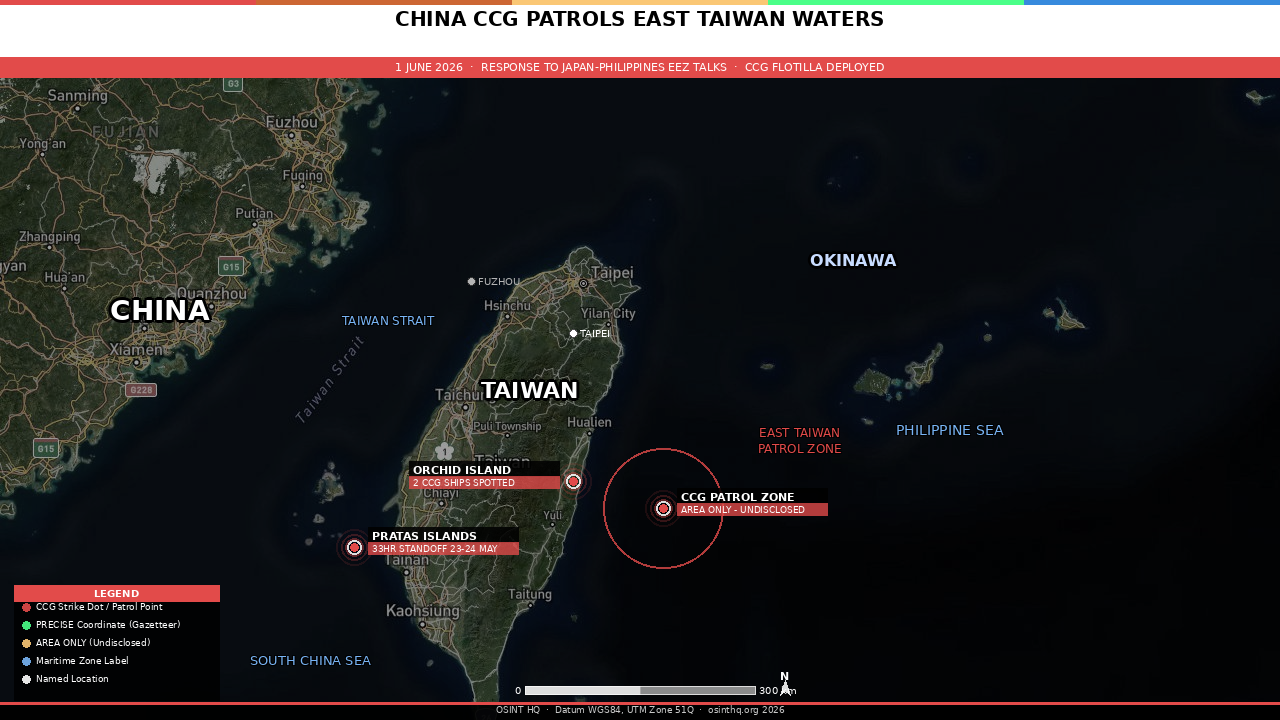
Philippine Sea east of Taiwan showing China Coast Guard patrol area, Orchid Island observation point, Pratas Islands, and the approximate overlap zone of the Japan-Philippines EEZ and continental shelf delimitation talks. EEZ claim lines approximate per open-source reporting as of 1 June 2026. Map: OSINT HQ / OSINT. Datum WGS84, UTM Zone 51R. ©osinthq.org 2026
| 📍 ORCHID ISLAND (LANYU), TAIWAN PRECISE MGRS: 51R TU 53344 43946 22.0500°N 121.5333°E Taiwan-administered island in the Philippine Sea, 90 km off the southeastern coast of Taiwan. Taiwan’s Coast Guard spotted two Chinese vessels operating southeast of this island on 1 June 2026; neither entered restricted waters. Source: Wikipedia infobox / GeoNames. Confirmed by Reuters wire citing Taiwan Coast Guard, 1 June 2026. | 📍 PRATAS ISLANDS (DONGSHA), TAIWAN PRECISE MGRS: 49Q XH 17000 29000 20.7000°N 116.7170°E Taiwan-administered atoll at the northern end of the South China Sea, approximately 400 km from Taiwan island. CCG vessel 3501 conducted a 33-hour standoff with Taiwan’s Coast Guard here on 24 to 25 May 2026. Site of ongoing Chinese pressure campaign, with four CCG incursions into restricted waters recorded in 2026 to date. Source: Wikipedia / Dongsha Airport ICAO record (RCLM). Cross-confirmed Stars and Stripes, Reuters, CNA reporting, May 2026. |
| 📍 CCG PATROL ZONE, EAST OF TAIWAN AREA ONLY Approximate Area Centre of indicative zone. Exact patrol track not publicly disclosed. China Coast Guard did not disclose the specific course or positions of the patrol. The general operating area is east of Taiwan island in the Philippine Sea, broadly overlapping the waters between Taiwan, the Ryukyu Islands, and the northern Philippines where Japan and the Philippines intend to delimit their EEZ and continental shelf boundary. Source: Approximate per China Coast Guard statement via CGTN / Xinhua, 1 June 2026. Patrol track not disclosed. | 📍 OKINOTORI, JAPAN (REFERENCE) PRECISE MGRS: 53Q MS 09000 25000 20.4225°N 136.0900°E Japan’s southernmost territorial claim in the Philippine Sea: a reinforced coral atoll that Tokyo argues generates a full 200 nm EEZ. SCMP notes Japan and the Philippines do not share a maritime border but that their seabed claims could overlap as both look to extend continental shelves beyond 200 nautical miles. Reference point for understanding the EEZ overlap geometry. Source: Wikipedia infobox, Okinotori. Reference point only. |
SITREP Timeline : East Taiwan / Philippine Sea Escalation, May to June 2026
🔴 The 1 June Patrol
A Flotilla With No Disclosed Track, A Claim With No Legal Standing, And Taiwan Watching From Orchid Island
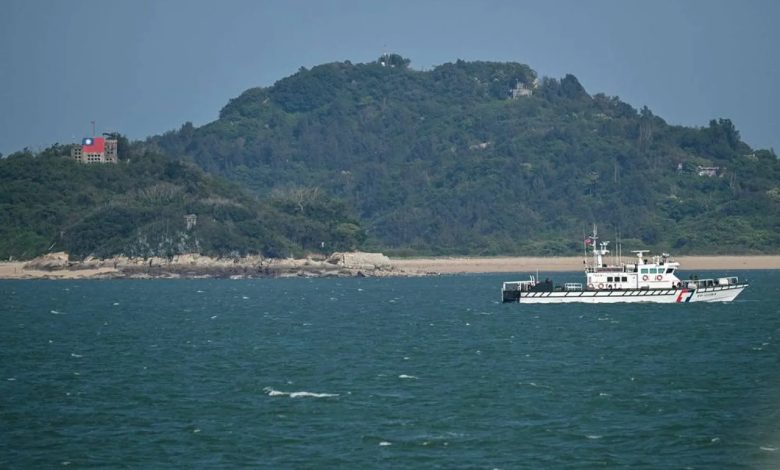
China’s Coast Guard announced its patrol of waters east of Taiwan on the morning of 1 June through spokesperson Jiang Lue, identifying the operation as a direct and necessary response to the Japan-Philippines delimitation announcement. The statement named a flotilla operating “to the east of Taiwan” but did not disclose a specific track, vessel count, class, or position. What Beijing provided was a political framing, not a navigational log. Taiwan’s Coast Guard Administration filled in one data point: two Chinese vessels were operating southeast of Orchid Island (Lanyu, MGRS 51R TU 53344 43946), a Taiwan-administered volcanic island in the Philippine Sea approximately 90 kilometres off Taiwan’s southeastern coast. Neither vessel entered restricted waters.
The legal architecture China is contesting is specific. Japan and the Philippines do not share a direct maritime boundary in the conventional 200-nautical-mile EEZ sense, because the two countries are separated by more than 400 nautical miles at their closest points. What they do share is a potential overlap in extended continental shelf claims beyond the 200-nautical-mile limit, particularly in the area of the Philippine Sea east of Taiwan and south of the Ryukyu Island chain. Japan’s claim here rests in part on Okinotori (MGRS 53Q MS 09000 25000), a reinforced coral atoll 1,740 kilometres south of Tokyo that Tokyo argues qualifies as an island generating a full EEZ; China disputes that categorisation, arguing Okinotori is a rock. The SCMP noted explicitly that both Japan and the Philippines are looking to extend legal continental shelves beyond 200 nautical miles, and that their claims in this space could overlap.
Beijing’s problem with the talks is not merely that Japan and the Philippines disagree about where a boundary runs. It is that any bilaterally agreed Japan-Philippines boundary in these waters implicitly excludes Chinese sovereignty from the same space. If Tokyo and Manila treat the area east of Taiwan as their exclusive zone for boundary negotiations, they are treating it as beyond China’s reach, which Beijing finds unacceptable given its claim to an exclusive economic zone and continental shelf extending from the Chinese mainland across Taiwan and into the Pacific. The Foreign Ministry’s language of “completely illegal, null and void” is standard procedural rejection intended to preserve Beijing’s standing for any future legal proceedings, not an invitation to negotiation.
🟡 The Tokyo Summit Package
Marcos and Takaichi Signed More Than a Sea Boundary Agreement: They Signed a Defence Partnership
The 28 to 29 May Tokyo summit between Philippine President Ferdinand Marcos Jr. and Japanese Prime Minister Sanae Takaichi produced a joint statement that Beijing has read, correctly, as a multi-front package. The maritime delimitation talks were one component. The elevation of bilateral ties to a comprehensive strategic partnership was another. But the most operationally significant element for China’s immediate threat calculus was the defence section: the two leaders committed to further promoting arms transfers including destroyers, TC-90 aircraft, and radar systems, and stated that Japan would continue contributing to the capacity building of the Armed Forces of the Philippines. Japanese media, including The Independent coverage cited by GlobalSecurity, noted that Marcos Jr. represents the first potential major customer for Japanese lethal weapons exports since Prime Minister Takaichi’s government lifted a ban on such transfers in April 2026. That policy shift, from postwar pacifist restraint to active arms exporter, has China’s attention in a way that pure maritime delimitation talks alone would not.
Coast guard cooperation was also embedded in the joint statement, specifically through joint training and capacity-building activities. This matters because it mirrors the pattern Beijing has been trying to disrupt in the South China Sea for three years: the Philippines, with Japanese and US backing, has been reinforcing its coast guard presence and legal documentation of Chinese incursions. Bringing Japanese coast guard expertise into that framework extends the pressure beyond the South China Sea into the Pacific waters east of Taiwan. China’s response has been, as of 1 June, a symbolic flotilla patrol and a diplomatic protest. How long Beijing considers those tools sufficient is an open question.
🔵 The Pratas Context
A 33-Hour Standoff One Week Ago: The CCG Is Already Pressing Taiwan’s Southern Anchor Point
The 1 June patrol east of Taiwan does not exist in isolation. One week earlier, from 24 to 25 May, China Coast Guard vessel CCG-3501, a 5,500-ton patrol ship, entered the restricted waters around Taiwan’s Pratas Islands (Dongsha, MGRS 49Q XH 17000 29000) and engaged in a 33-hour radio standoff with Taiwan’s Coast Guard cutter Taichung. The Pratas are a coral atoll at the northern end of the South China Sea, lying roughly between southern Taiwan and Hong Kong, approximately 400 kilometres from Taiwan island and garrisoned by around 300 Taiwanese coast guard personnel. CCG-3501 eventually departed at 17:00 local on 25 May, having been broadcasting Chinese sovereignty and jurisdiction claims throughout the standoff. Taiwan’s CGA reported the incident and noted that four CCG vessels had entered Pratas restricted waters on six occasions in 2026 to date, a significant increase from prior years.
The Global Taiwan Institute, in an analysis published the same week, noted that China has been deploying multiple coercive tactics around Dongsha beyond coast guard patrols: oil exploration structures have been placed inside the atoll’s exclusive economic zone in recent periods. Security analysts quoted in multiple outlets describe Pratas as potentially vulnerable to Chinese seizure given its isolation and small garrison. Taiwan Defense Minister Wellington Koo, speaking to parliament on 1 June about the Pratas situation, said the military would provide necessary assistance to the Coast Guard under joint cooperative protocols, without elaborating on what form that would take. The navy-to-Coast Guard protocol language signals that Taiwan is preparing for scenarios where a standoff at Pratas escalates beyond what a 1,000-ton coast guard cutter can manage alone.
Read together, the Pratas pressure and the Pacific patrol represent two axes of a single Chinese operational posture: the South China Sea southern flank and the Philippine Sea eastern flank of Taiwan’s maritime periphery. Beijing is simultaneously contesting Taiwan’s administered territories in both directions. The Japan-Philippines delimitation announcement inserted a third party into the eastern axis, which is what triggered the 1 June patrol rather than a purely bilateral Taiwan confrontation of the Pratas type.
⚠ Taiwan’s Position
Taipei Rejects Both Beijing’s Sovereignty Claim and Its Framing of the Patrol as Legitimate Enforcement
Taiwan’s response to Beijing’s actions across both the Pacific and South China Sea fronts has been consistent in form but calibrated in tone. On the maritime front, Taiwan’s Coast Guard Administration described China’s 1 June patrol as illegal “law enforcement activity” and stated that the Republic of China’s sovereignty must not be infringed upon. On the diplomatic front, Taiwan’s foreign ministry, in a statement issued late on 31 May before the patrol was announced, declared that China has no right to interfere in Taiwan’s territorial sovereignty and sovereign rights over relevant maritime areas. The ministry’s statement was targeted at Beijing’s objection to the Japan-Philippines talks; the implicit argument is that any waters China attempts to claim as its own by treating Taiwan as Chinese territory are, from Taipei’s perspective, subject to the Republic of China’s sovereign authority, not Beijing’s.
President William Lai separately stated on 31 May that Taiwan would bolster its defence capabilities and economic resilience in response to growing Chinese pressure, with the goal of deterring conflict through strength. Defense Minister Wellington Koo framed this at the Shangri-La Dialogue context as sharing deterrence responsibility with regional partners and maintaining close engagement with the United States. US Secretary of Defense Pete Hegseth, also at Shangri-La, underscored the need for allies to increase defence spending and stated that Washington would prioritise working with what he called model allies who are ready to defend their national interests. The implicit alignment between US expectations and Taiwan’s signalled posture suggests Taipei is positioning to be seen as meeting that bar, which carries weight in any future calculation about US material support for Taiwan’s coast guard or navy in a Pratas-type scenario.
China Coast Guard Spokesperson Jiang Lue : CCG Statement, 1 June 2026
“This is a necessary action taken in response to Japan and the Philippines unilaterally announcing the initiation of maritime boundary delimitation negotiations in the waters east of China’s Taiwan island. We urge Japan and the Philippines to immediately cease all illegal actions that undermine China’s sovereignty, rights and interests.”
Source Reliability Matrix
NATO grading: REL A (reliable) to F (unreliable). CRED 1 (confirmed) to 6 (cannot judge).
CRED 1
Primary wire. Carried verbatim by Japan Times, Japan Today, Free Malaysia Today, BusinessWorld, Taipei Times, and Rappler. Cross-confirmed across six outlets.
CRED 1
Official Chinese state statement on patrol. Reliable as a statement of Chinese government position. Graded CRED 1 on the narrow question of whether China conducted and announced the patrol. Assessment of the patrol’s legal basis is disputed.
CRED 2
Government source on vessel sightings. CRED 2 because the observation of two ships near Orchid Island is operationally credible but does not describe the full patrol scope.
CRED 1
Primary government document. Confirmed and reported by SCMP, HKFP, GlobalSecurity, and multiple Philippine outlets.
CRED 2
Non-governmental think-tank focused on Taiwan-related analysis. Analytical framing used for context only; factual claims cross-checked against CGA statements.
OSINT HQ Assessment
Beijing is contesting a legal process it cannot stop by military means it cannot easily deploy; the patrol east of Taiwan is a statement of objection, not a demonstration of control.
✓ What We Know
China Coast Guard conducted a patrol east of Taiwan on 1 June 2026, explicitly framing it as a response to the Japan-Philippines EEZ delimitation announcement made at the 29 May Tokyo summit. Taiwan’s Coast Guard spotted two Chinese vessels southeast of Orchid Island (MGRS 51R TU 53344 43946); neither entered restricted waters. China’s Foreign Ministry declared the talks illegal and lodged formal protests with Tokyo and Manila on 30 May. The summit also produced a Japan-Philippines comprehensive strategic partnership including arms transfers and coast guard cooperation. A separate 33-hour China Coast Guard standoff occurred at Taiwan’s Pratas Islands (MGRS 49Q XH 17000 29000) on 24 to 25 May. Taiwan’s Defense Minister confirmed the navy will assist the Coast Guard under joint protocols. The SCMP confirms Japan and the Philippines do not share a direct maritime border but have overlapping extended continental shelf claims that motivated the delimitation announcement.
? What We Do Not Know
The number and class of vessels in the China Coast Guard flotilla beyond the two observed near Orchid Island. Whether the patrol entered any area that Japan or the Philippines would regard as their EEZ. The exact scope of the Japan-Philippines delimitation talks, including whether Okinotori’s status as an island or rock was addressed in the joint statement, and how each side proposes to handle the overlapping extended continental shelf geometry. Whether the Xi-Trump discussions of 20 May included any understanding on Taiwan that informed the subsequent acceleration of Chinese coast guard activity. Whether Japan intends to deploy its own coast guard in the disputed area as part of the bilateral cooperation framework.
☉ What To Watch
Whether China Coast Guard returns to Pratas with greater frequency or larger vessels in the weeks following the 1 June patrol, testing whether Taiwan will activate the naval assistance Wellington Koo signalled. Whether the Japan-Philippines delimitation talks produce a first formal meeting, which would trigger a second round of Chinese counter-moves. Whether Japan deploys coast guard vessels to the area east of Taiwan under the new bilateral cooperation framework, and whether Beijing treats that as a qualitative escalation. Whether the Philippines presses for a UNCLOS arbitration panel or a third-party legal mechanism for the east-of-Taiwan boundary, and how China responds to multilateral legal process as distinct from bilateral diplomatic protest. Whether the US takes a position on the Japan-Philippines EEZ talks, particularly in light of the US-Japan alliance and the US-Philippines Mutual Defense Treaty, both of which could be implicated if Chinese vessels confront Japan or Philippine coast guard ships in the claimed area.
Sources
- China Patrols Waters East of Taiwan in Response to Japan, Philippine Maritime Border Talks, Asharq Al-Awsat via Reuters, 1 June 2026
- China Coast Guard Patrols Waters East of Taiwan Island Amid Japan-Philippines Delimitation Talks, CGTN, 1 June 2026
- China Coast Guard Patrols Waters East of Taiwan Island, Xinhua, 1 June 2026
- China Patrols Waters East of Taiwan in Response to Japan, Philippine Maritime Border Talks, Taipei Times, 1 June 2026
- China Patrols Waters East of Taiwan in Response to Japan, Philippine Maritime Border Talks, Japan Times, 1 June 2026
- Illegal and Void: China Condemns Japan-Philippines Maritime Border Talks, South China Morning Post, 30 May 2026
- China Blasts Illegal Japan-Philippines Sea Border Talks, Hong Kong Free Press, 29 May 2026
- Coast Guard Ships from China, Taiwan Clash in Disputed South China Sea Waters, Stars and Stripes, 26 May 2026
- Lai Vows to Bolster Defense, Resilience, Taipei Times, 31 May 2026
- China’s Next Target in the South China Sea: Taiwan?, Global Taiwan Institute, May 2026
Editorial Verification
The China Coast Guard patrol announcement of 1 June is confirmed by Reuters wire (carried by six independent outlets), CGTN, and Xinhua. The Taiwan Coast Guard’s observation of two Chinese vessels southeast of Orchid Island is from a Taiwan CGA statement cited in Reuters. The Japan-Philippines joint statement of 29 May is confirmed by SCMP, HKFP, GlobalSecurity, and multiple Philippine outlets. Chinese Foreign Ministry spokesperson Mao Ning’s statement of 30 May is confirmed by multiple wires. Taiwan Defense Minister Wellington Koo’s parliamentary remarks of 1 June are confirmed by Reuters and Japan Today. The Pratas standoff of 24 to 25 May is confirmed by Reuters, Stars and Stripes, Taipei Times, and Taiwan CNA. The Xi-Trump meeting date of 20 May is sourced to officials familiar with discussions, cited by IBTimes Singapore and GlobalTaiwan Institute; flagged as single-source attribution from background officials.
Coordinates and map (v8): Orchid Island (Lanyu): PRECISE marker sourced from Wikipedia infobox (22.050N, 121.533E) and cross-confirmed by GeoNames. MGRS 51R TU 53344 43946 computed from sourced lat/lon. Pratas Islands (Dongsha): PRECISE marker sourced from Dongsha Airport ICAO record (RCLM) coordinates 20.700N, 116.717E, cross-confirmed by Wikipedia. MGRS 49Q XH 17000 29000 computed from sourced lat/lon. Okinotori: PRECISE reference marker sourced from Wikipedia infobox (20.4225N, 136.090E). MGRS 53Q MS 09000 25000 computed from sourced lat/lon. China Coast Guard patrol zone east of Taiwan: AREA ONLY. China’s statement named no specific coordinates; exact patrol track is not publicly disclosed. Static map produced with PIL overlay script sb-map-overlay.py on a satellite base image. Third-party watermarks removed from base before overlay. Territory fills, patrol zone, and location markers are approximate per open-source reporting. No classified imagery used. No third-party watermarks appear in the published image.
MGRS datum: WGS84 / UTM Zones: 51R (East Taiwan / Orchid Island), 49Q (Pratas), 53Q (Okinotori) / Cross-check reference: Orchid Island (Lanyu) MGRS 51R TU 53344 43946
All claims independently attributed and verified to open sources where possible.
Approved for Publication
Marcus V. Thorne
Lead Editor, OSINT HQ
©osinthq.org 2026
This article is for news and analysis purposes only. Based on publicly available news sources and military updates. All rights reserved. Not for commercial reuse without permission.