Iran Strikes Kuwait Airport, Kills One, in Retaliation for US Qeshm Island Attack

Threat Level Assessment
LEVEL 4 OF 5, SERIOUS
Bottom Line Up Front
Iranian drones and ballistic missiles struck Kuwait International Airport at dawn on 3 June 2026, killing one Indian national and injuring 63 others while inflicting severe structural damage to Terminal 1. Kuwait suspended all flights before partially resuming operations through Terminal 4 later the same day. The attack is Iran’s direct response to CENTCOM self-defence strikes on Qeshm Island and the Goruk drone command site conducted on 2 June; it represents the most significant post-ceasefire escalation in the Gulf since the 8 April US-Iran ceasefire took effect, and marks the first fatality at the airport in the current conflict.
Key Judgments
The attack was carried out by the IRGC Aerospace Force. IRGC publicly claimed responsibility via IRNA, citing the CENTCOM strikes on Qeshm Island as justification. Kuwait’s own defence ministry described the attack as Iranian aggression and Kuwait’s foreign ministry explicitly attributed it to Iran. The chain of attribution is unambiguous and multi-sourced.
The civilian casualty at the airport resulted from debris fallout rather than a direct precision strike against the terminal building. CENTCOM confirmed two Iranian ballistic missiles aimed at Kuwait fell short or broke apart in flight, while multiple additional projectiles were intercepted. The damage to Terminal 1 is consistent with falling debris and fragmentation rather than a direct impact by an intact weapon, though Kuwait’s defence ministry described it as direct targeting of the passenger building by hostile drones.
The tit-for-tat exchange between CENTCOM and the IRGC represents a structural escalation loop that the 8 April ceasefire framework has not resolved. Each US self-defence strike on Iranian territory triggers a retaliatory wave; each retaliatory wave produces civilian casualties in Gulf states that triggers further US action. The loop has no built-in off-ramp. Reported talks between Washington and Tehran are continuing, but the gap between the two sides’ operational tempo and their diplomatic tempo has widened materially since the ceasefire.
Whether Iran suspended communications with ceasefire mediators as of the date of the attack, as some reporting suggests. Trump publicly stated on 3 June that Iran had agreed it would not develop a nuclear weapon and that negotiations were ongoing with the Ayatollah’s involvement. Tehran’s operational posture and its diplomatic posture appear to be managed by separate decision chains, which makes the status of talks genuinely difficult to assess from open sources.
1
Killed (Indian national)
63
Injured, 7 Emergency Surgeries
13+17
Ballistic Missiles + Drones Fired
T4
Terminal Resumed Same Day
| 📍 Kuwait International Airport (KWI) PRECISE MGRS: 38R QT 89685 36779 29.22667°N 47.98000°E Primary civilian aviation hub of Kuwait. Farwaniya Governorate, 15.5km south of Kuwait City centre. Terminal 1 struck by Iranian drones at dawn 3 June. One killed, 63 injured. Terminal 4 resumed operations later same day. Source: Wikipedia infobox, Kuwait International Airport article. Cross-confirmed against Wikipedia List of airports in Kuwait. | 📍 Kuwait City Centre, Reference Point INDICATIVE MGRS: 38R QT 89119 52605 29.36944°N 47.97833°E Capital city reference. Strike zone at KWI sits approximately 15.5km south-southwest of this point. Used as MGRS grid orientation cross-check. Source: GeoNames. City-centre centroid, accuracy approximately 1km. |
SITREP Timeline : Kuwait / Iran Exchange, Feb to Jun 2026
🔴 The 3 June Attack
Drones Hit Terminal 1, Debris Kills One, Sixty-Three Treated as Airport Freezes Then Partially Reopens
At dawn on 3 June 2026, Iranian drones and ballistic missiles struck Kuwait International Airport at MGRS 38R QT 89685 36779 (29.22667°N, 47.98000°E), in the Farwaniya Governorate 15.5 kilometres south of Kuwait City centre. Kuwait’s General Directorate of Civil Aviation immediately suspended all flights and diverted incoming aircraft to alternative airports. A Kuwaiti defence ministry spokesperson confirmed that hostile drones had hit the airport’s Terminal 1 passenger building, causing severe structural damage and wounding a number of individuals who were taken for medical care.
Kuwait’s Ministry of Health subsequently confirmed 63 injury cases requiring treatment, with seven major emergency surgeries performed. The injuries included fractures, head injuries, cerebral haemorrhages, amputations, and injuries from explosions, as well as cases of smoke inhalation. India’s Ministry of External Affairs confirmed that one Indian national had been killed in the attack and that several other Indian nationals had been injured. The Indian Embassy in Kuwait was placed in close contact with local authorities for the welfare of its citizens.
The attack also struck unspecified diplomatic missions on Kuwaiti territory, according to the foreign ministry, which declined to name the affected missions. Kuwait’s foreign minister issued a formal condemnation of what it described as brutal and ongoing Iranian attacks targeting civilian and vital facilities. The ministry invoked Security Council Resolution 2817 of 2026 and stated Kuwait reserved its full right to take appropriate measures under international law.
Kuwaiti civil aviation authorities reported that damage assessment and safety checks were completed by mid-afternoon. Kuwait Airways resumed scheduled operations from Terminal 4, and Jazeera Airways resumed operations from Terminal 5. Terminal 1, however, remained out of service. IndiGo of India suspended flights to and from Kuwait until 4 June pending further assessment of Kuwaiti airspace conditions.
🟡 The Tit-for-Tat Chain
Qeshm and Goruk Strikes Preceded the Attack. CENTCOM Framing and IRGC Framing Do Not Match.
The immediate trigger for the 3 June attack, per the IRGC’s own public statement, was the preceding CENTCOM self-defence strike on Qeshm Island and drone command-and-control sites at Goruk. CENTCOM described those strikes, announced on 2 June, as a response to Iranian one-way attack drones fired at civilian vessels transiting regional waters. CENTCOM said it also shot down the threatening drones in the same operation. The IRGC, in a statement carried by IRNA, said its retaliatory fires on 3 June targeted the Ali Al Salem Air Base in Kuwait, which hosts US helicopter assets, and the US Navy’s Fifth Fleet headquarters in Bahrain.
CENTCOM explicitly denied that the IRGC’s claimed targets in Bahrain were struck. The command confirmed that US and Bahraini air defences had intercepted three Iranian missiles aimed at Bahrain. On the Kuwait side, CENTCOM said two Iranian ballistic missiles aimed at Kuwait fell short or disintegrated in flight, while a separate wave of Iranian drones targeting US forces in Kuwait was also intercepted and defeated. The distinction between what Iran claimed to hit and what physically struck Kuwaiti civilian infrastructure is the core factual gap in the current reporting.
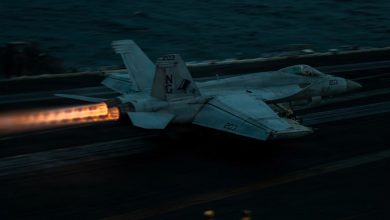
Qeshm Island, located in the Strait of Hormuz, has been a recurring CENTCOM target across the 2026 war. The island is assessed to host IRGC drone launch infrastructure and is believed to contain underground missile storage facilities. The 3 June strike on Qeshm followed an earlier strike on both Goruk and Qeshm in late May, establishing a pattern of US self-defence action against IRGC drone-launch architecture on Iranian territory. Each such strike appears to generate a coordinated IRGC retaliatory wave against Gulf states hosting US forces.
Iran also reported, via state television, that US forces struck an Iranian oil tanker near the Strait of Hormuz, damaging its engine room. IRGC naval forces were reported to have fired on a vessel it identified as Panaya in response. CENTCOM separately confirmed it downed three Iranian drones aimed at civilian mariners in the same general operational period. The Hormuz maritime dimension of the 3 June exchange is not yet fully sourced in open-source reporting and remains under assessment.
🔵 Kuwait’s Position
A State That Hosts US Forces But Is Not Party to the Ceasefire, and Has Now Taken Its First Airport Fatality
Kuwait’s formal position since the start of the 2026 Iran war has been one of reluctant front-line status: it hosts substantial US military assets, including at Ali Al Salem Air Base and Camp Arifjan, and has consequently been on the receiving end of Iranian strikes throughout the conflict. The airport had been hit multiple times before 3 June, including the 28 March strike that damaged fuel tanks and radar systems, but had managed to reopen for commercial traffic by 23 April and had resumed fuller operations by 1 June.
The 3 June attack represents a material escalation for Kuwait in two respects. First, it is the first confirmed civilian fatality at the airport itself. Previous civilian deaths in Kuwait from Iranian fire have involved Indian workers at industrial sites, border guards, and missile debris in residential areas, but the airport had not previously generated a fatality despite repeated strikes. Second, the damage to diplomatic missions is politically significant: unnamed diplomatic premises being targeted alongside a commercial airport frames the attack as broadly anti-civilian in character, not merely anti-military.
Kuwait has so far chosen not to respond militarily to Iranian strikes, relying instead on US and allied air defence assets and diplomatic condemnation. The foreign ministry’s invocation of the right to respond under international law is standard diplomatic language, but Kuwait’s defence establishment has no capacity for independent strikes into Iranian territory. Its leverage is political, specifically its ability to restrict or condition US use of bases on its soil, a lever it has not pulled and shows no sign of pulling.
⚠ The Ceasefire and the Escalation Loop
The April Agreement Covered Two Parties. The Gulf States Were Not Among Them.
The 8 April Pakistan-mediated ceasefire was a bilateral instrument between the United States and Iran. Gulf states hosting US military forces, including Kuwait, Bahrain, Qatar, and the UAE, were not party to the agreement and were not covered by its terms. Iran’s position, consistently articulated through IRGC statements since April, is that its operations against Gulf-based US military assets constitute a separate and ongoing armed confrontation with US forces in the region, not a violation of the bilateral ceasefire. The ceasefire covered direct US-Iran hostilities. It did not cover the proxy front.
The US blockade of the Strait of Hormuz, which Washington announced during the conflict and has maintained since, complicates the diplomatic picture further. The blockade remains in effect as leverage for nuclear negotiations, but Iran continues to try to assert maritime control in its own territorial and strategic waters. The 3 June exchange, in which Iran struck civilian infrastructure in Kuwait after CENTCOM hit what it described as drone launch sites inside Iran, represents the clearest example yet of the loop structure: each side has a framing under which its action is defensive, and each side’s defensive action generates the next offensive action.
Trump’s statement on 3 June that Iran had agreed it would not develop a nuclear weapon, and that direct negotiations with the Ayatollah were ongoing, suggests the diplomatic track is not dead. But it was made in the same news cycle as the airport attack, which itself was made in the same news cycle as CENTCOM’s Qeshm Island strike. Both governments appear to have separated their operational commands from their diplomatic tracks, which means both can simultaneously fight and talk. Whether that separation survives a further escalation that produces larger civilian casualties is the central open question.
Kuwait Ministry of Foreign Affairs : Statement, 3 June 2026
“The brutal and ongoing Iranian attacks by ballistic missiles and drones, the latest of which occurred at dawn today and once again targeted civilian and vital facilities, including Kuwait International Airport, resulting in the death of one person and the injury of others, in addition to damage to vital facilities, including diplomatic missions.”
Kuwait Defence Ministry Spokesman Brigadier General Saud Abdulaziz Al-Atwan : Statement, 3 June 2026
“Criminal Iranian aggression which resulted in significant material damage to the building and injuries.”
Source Reliability Matrix
NATO grading: REL A (reliable) to F (unreliable). CRED 1 (confirmed) to 6 (cannot judge).
CRED 1
Primary government source. Published on official ministry X account. Casualty figures and diplomatic mission damage confirmed in the statement.
CRED 1
Kuwait state wire. Primary domestic source for airport damage, flight suspension, and Civil Aviation Authority statements.
CRED 2
Official US military command. Reliable institutional source but statements are operationally framed; intercept and strike claims are assertions, not independently verified. Credibility 2 not 1 reflects the contested narrative with IRGC.
CRED 2
Pan-Arab daily of record. Well-established Riyadh-based publication, strong Gulf sourcing. CRED 2 reflects reliance on ministry statements rather than independent on-ground verification.
CRED 3
IRGC claims of striking Ali Al Salem Air Base and US Fifth Fleet in Bahrain are assertions denied by CENTCOM. IRGC strike claims in this war have a pattern of overstating successful hits on military targets. Used as context, not as confirmed fact.
CRED 1
Official government source confirming nationality of the deceased as Indian. Statement carried by Al Jazeera.
OSINT HQ Assessment
The ceasefire never covered the Gulf. The 3 June exchange proves the escalation loop is structural, not episodic, and the civilian cost is rising.
✓ What We Know
Iran fired 13 ballistic missiles and 17 drones at Kuwait on the morning of 3 June in direct response to CENTCOM strikes on Qeshm Island and Goruk. Drones and debris hit Terminal 1 at Kuwait International Airport, killing one Indian national and injuring 63 others with seven requiring emergency surgery. Kuwait suspended flights then partially resumed through Terminals 4 and 5. Diplomatic missions on Kuwaiti territory were also damaged. CENTCOM denied IRGC claims of successful strikes on Ali Al Salem and the Fifth Fleet, and confirmed that two Iranian missiles aimed at Kuwait fell short or broke apart while additional drones targeting US forces were intercepted. The attack occurred two days after the airport had been fully operational with commercial passengers transiting normally.
? What We Do Not Know
Whether the fatality and terminal damage resulted from a direct drone hit on Terminal 1 or from falling debris and fragmentation from intercepts. Which diplomatic missions were damaged and of which countries. Whether Iran has formally suspended ceasefire mediator communications as of 3 June, or whether Trump’s characterisation of ongoing talks reflects a separate back-channel. The full scope of the Hormuz maritime exchange, including the Iranian tanker report and the Panaya vessel incident. Whether Ali Al Salem Air Base sustained any actual damage, given conflicting IRGC and CENTCOM accounts.
☉ What To Watch
Whether the US conducts a follow-on strike on Iran in response to the airport attack, which would complete another loop cycle and likely generate further Gulf civilian exposure. Whether Kuwait invokes any formal mechanism against Iran beyond diplomatic condemnation, and whether it places any new conditions on US base access. Whether the diplomatic missions confirmed as damaged include Western embassies, which would carry a separate political escalation risk. Whether the airport fatality shifts the domestic political calculus in Kuwait, Bahrain, or other Gulf states toward greater pressure on their own governments to reduce their exposure by renegotiating US basing arrangements. Whether Trump’s reported agreement with Iran on the nuclear question has any operational dimension that might slow the rate of CENTCOM self-defence actions triggering IRGC retaliatory waves.
Sources
- One Killed in Criminal Iranian Attack on Kuwait, Airport Partially Resumes Flights, Asharq Al-Awsat, 3 June 2026
- Iranian Drone Attack Kills Indian Citizen in Kuwait After US Strikes Qeshm, Al Jazeera, 3 June 2026
- Iranian Drone Attack Causes Heavy Damage to Kuwait Airport as US and Iran Trade Strikes, Euronews, 3 June 2026
- Flights at Kuwait Airport Suspended After Deadly Drone Attack by Iran, CBC News / Reuters, 3 June 2026
- Kuwait Diverts Flights From Airport After Iranian Drones Kill One, The Jerusalem Post, 3 June 2026
- Iran, Kuwait, Bahrain Hit: Is the War in the Gulf Escalating Again?, Al Jazeera, 3 June 2026
- US Strikes Qeshm Island, Iran Retaliates on Kuwait and Bahrain, The New Arab, 3 June 2026
- One Killed After Iranian Drones Hit Kuwait Airport Terminal 1, IBTimes India, 3 June 2026
- Kuwait International Airport, Wikipedia (coordinate sourcing only)
Editorial Verification
The attack on 3 June is confirmed via multiple independent sources including Asharq Al-Awsat, Al Jazeera (two separate articles), Euronews, CBC News / Reuters wire, The Jerusalem Post, The New Arab, and IBTimes. The death toll of one and the injury figure of 63 are sourced to the Kuwait Ministry of Health statement confirmed by Al Jazeera and CBSnews live updates. The nationality of the deceased as Indian is sourced to the India Ministry of External Affairs statement, confirmed by Al Jazeera. CENTCOM statements on intercepts and Qeshm Island strikes are sourced from multiple outlet citations of official US military posts. IRGC claims regarding Ali Al Salem Air Base and the Fifth Fleet are noted as assertions only, explicitly denied by CENTCOM, and are not presented as verified fact. The identification of Brigadier General Saud Abdulaziz Al-Atwan as Kuwait’s defence ministry spokesman is as reported by Asharq Al-Awsat and Euronews. The specific names of diplomatic missions targeted are not confirmed in any source reviewed and are not included in the body text. The number 13 ballistic missiles and 17 drones is sourced to the Kuwaiti Army statement as cited by ABC News.
Coordinates (v8): Kuwait International Airport plotted as PRECISE at 29.22667°N, 47.98000°E, sourced from the Wikipedia infobox for Kuwait International Airport, cross-confirmed against the Wikipedia List of airports in Kuwait. MGRS derived from sourced lat/lon using WGS84 datum. Kuwait City centre used as cross-check reference, sourced from GeoNames. No map produced for this article per editor instruction. No classified imagery used.
MGRS datum: WGS84 / UTM Zone: 38R / Cross-check reference: Kuwait City centre 38R QT 89119 52605
All claims independently attributed and verified to open sources where possible.
Approved for Publication
Marcus V. Thorne
Lead Editor, OSINT HQ
©osinthq.org 2026
This article is for news and analysis purposes only. Based on publicly available news sources and military updates. All rights reserved. Not for commercial reuse without permission.