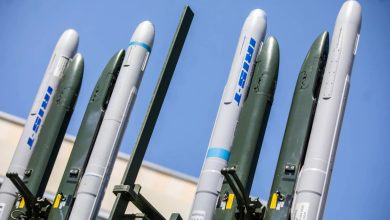
Russia Launches 265 Drones at Ukraine One Killed in Kherson, 40,000 Lose Power in Chernihiv
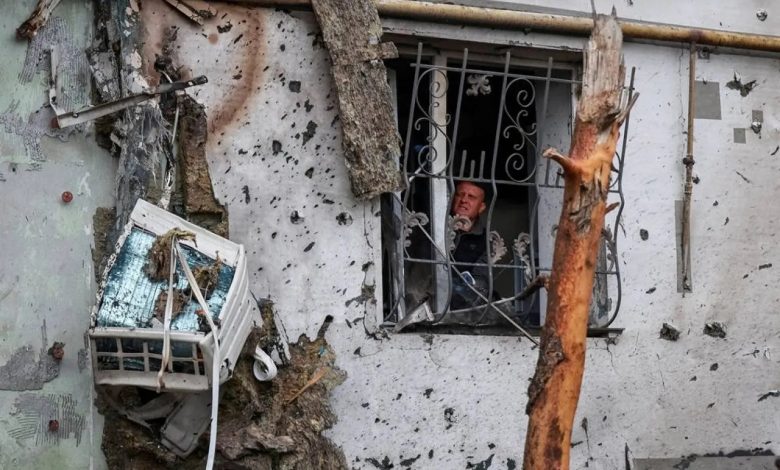
Threat Level Assessment
LEVEL 4 OF 5, SERIOUS
Bottom Line Up Front
Russian forces launched 265 combat drones across Ukraine on the night of 31 May to 1 June 2026, with Ukrainian air defence neutralising 228 of them, according to the Ukrainian Air Force via Interfax-Ukraine. Twenty-seven drones that penetrated defences struck 18 locations. One civilian was killed in the southern city of Kherson and at least 24 others were wounded across five cities, including eight in Chernihiv where power was cut to 40,000 customers. The barrage comes as direct peace talks between Kyiv and Moscow, resumed in Istanbul on 16 May after more than three years, are stalling ahead of a second Istanbul round on 2 June, with Russia refusing to commit to even a temporary ceasefire.
Key Judgments
Russia’s overnight drone campaign continues to function as a nationwide attrition instrument, not a precision military operation. A 265-drone barrage producing one confirmed fatality across five targeted cities reflects the persistent but limited kinetic effect of the Shahed-type one-way attack drone at scale. The strategic value to Moscow is economic and psychological, not military: infrastructure disruption, emergency service saturation, and population fatigue compound faster than hardware losses.
The timing of the barrage relative to the 2 June Istanbul talks is deliberate signalling. Russia’s pattern since the first Istanbul round on 16 May has been to refuse a full ceasefire while maintaining high-tempo attacks on civilian infrastructure. Continuing major drone operations into the eve of diplomatic meetings communicates that Russia is negotiating from a position it does not intend to compromise, regardless of whether a second meeting produces any agreement.
Whether the power cut to 40,000 customers in Chernihiv reflects a direct hit on a substation or is secondary grid disruption from adjacent infrastructure damage. Ukrinform confirmed the figure but did not identify the specific facility struck. The Chernihiv region has been repeatedly targeted for energy infrastructure and the distinction matters for Ukrainian repair-cycle estimates.
265
Combat Drones Launched
228
Drones Neutralised
24+
Civilians Wounded
5
Cities Struck
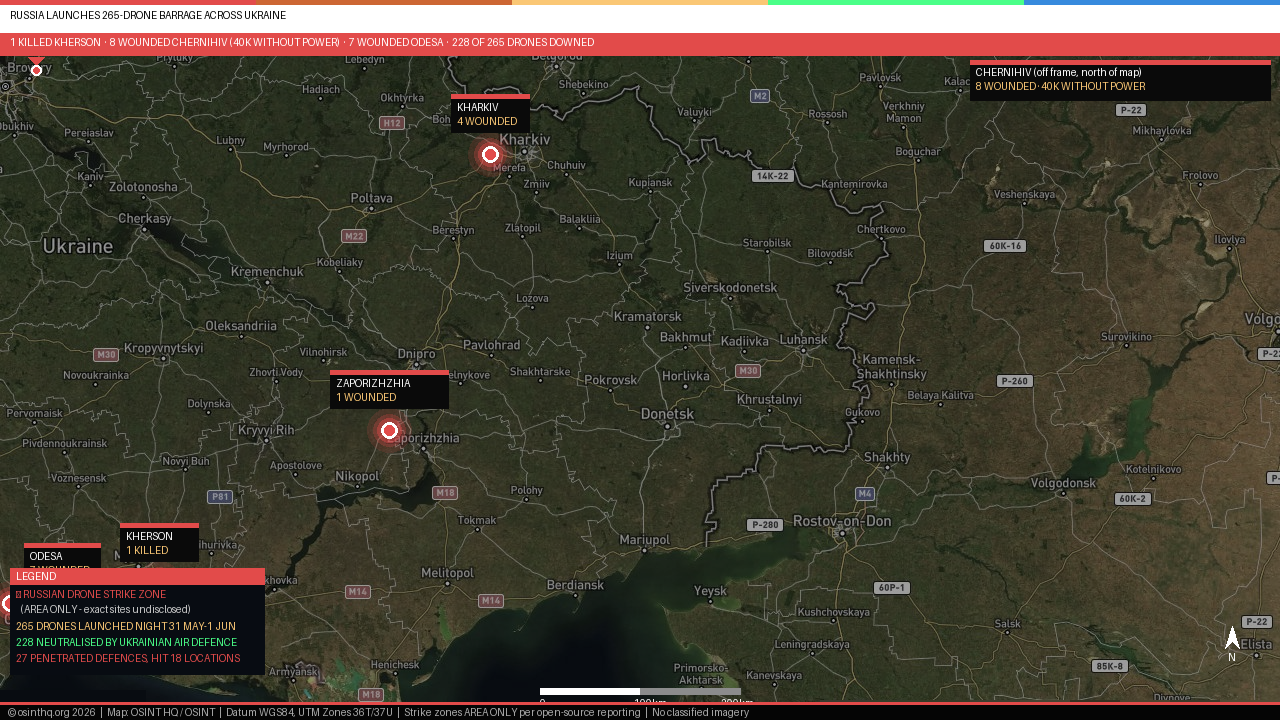
Russian drone strike locations, night of 31 May to 1 June 2026. Strike zones are AREA ONLY per open-source reporting; specific impact coordinates were not disclosed. Map: OSINT HQ / OSINT. Datum WGS84, UTM Zone 36T/37U. ©osinthq.org 2026
| 📍 KHERSON, STRIKE ZONE AREA ONLY Approximate Area Centre of indicative zone. Exact site not publicly disclosed. Kherson city, southern Ukraine. One civilian killed at a bus stop per Ukrinform and regional military administration. Reporting did not disclose the precise strike coordinate. City-centre reference: 36TVS7130065505 (46.6425N, 32.6250E). Source: Asharq Al-Awsat / Ukrinform; city centroid from Wikipedia infobox | 📍 CHERNIHIV, STRIKE ZONE AREA ONLY Approximate Area Centre of indicative zone. Exact site not publicly disclosed. Chernihiv city, northern Ukraine. Eight wounded including three children; large blaze visible in emergency service imagery; 40,000 electricity customers disconnected per Ukrinform. City-centre reference: 36UUC8126106616 (51.4982N, 31.2894E). Source: Asharq Al-Awsat / Ukrinform; city centroid from Wikipedia infobox |
| 📍 ODESA, STRIKE ZONE AREA ONLY Approximate Area Centre of indicative zone. Exact site not publicly disclosed. Odesa city, Black Sea port, southern Ukraine. Seven wounded per Asharq Al-Awsat; residential neighbourhoods and civilian infrastructure hit per Serhii Lysak, head of city administration. City-centre reference: 36TUS2525050177 (46.4825N, 30.7233E). Source: Asharq Al-Awsat / Ukrinform; city centroid from Wikipedia infobox | 📍 KHARKIV AND ZAPORIZHZHIA, STRIKE ZONES AREA ONLY Approximate Area Centre of indicative zone. Exact sites not publicly disclosed. Kharkiv city: four wounded per Asharq Al-Awsat. Reference: 37UCR0149741584 (49.9935N, 36.2304E). Zaporizhzhia city: one wounded. Reference: 36TXU6009700600 (47.8388N, 35.1396E). Both AREA ONLY; exact strike coordinates not disclosed. Source: Asharq Al-Awsat; city centroids from Wikipedia infoboxes |
SITREP Timeline : Russia-Ukraine Drone Campaign and Talks, May to June 2026
🔴 The 265-Drone Barrage
One Killed, Five Cities Struck, A Bus Stop And A Blaze That Cut Power To 40,000
On the night of 31 May into 1 June 2026, Russian forces launched 265 combat drones across Ukraine in a nationwide barrage covering at least five cities. The Ukrainian Air Force confirmed via Interfax-Ukraine that air defence systems neutralised 228 of the 265 inbound unmanned aerial vehicles, with 27 penetrating defences to strike 18 locations. The intercept rate of approximately 86 percent is consistent with recent Ukrainian air defence performance but still leaves a meaningful remainder capable of reaching urban areas.
In Kherson, one civilian was killed in a drone attack on a bus stop, according to Ukrinform citing the regional military administration, which stated that criminal proceedings had been opened. Kherson, the southern regional capital on the Dnieper, has been subjected to near-daily Russian strikes since Ukrainian forces retook the city in November 2022. Its proximity to the occupied left bank of the river, where Russian forces remain entrenched, makes it one of the most persistently targeted cities in Ukraine.
In Chernihiv, the northern regional capital approximately 150 kilometres northeast of Kyiv, eight people were wounded in the drone attack, including three children, per Ukrinform. Emergency services published imagery showing firefighters extinguishing a large blaze in the city during the night. Separately, the Chernihiv regional energy administration reported that 40,000 electricity customers were disconnected as a result of the strike. Whether the power loss was caused by a direct hit on grid infrastructure or by cascading protective shutdowns triggered by adjacent damage was not confirmed in available reporting at the time of writing.
🟡 Odesa, Kharkiv, Zaporizhzhia
Residential Neighbourhoods, Civilian Infrastructure, And A Spreading Pattern Across The Map
In Odesa, seven people were wounded when drones struck residential neighbourhoods and civilian infrastructure, according to Asharq Al-Awsat and confirmed by Serhii Lysak, the head of the city’s military administration, via Ukrinform. Odesa is Ukraine’s largest Black Sea port and has been a regular target since February 2022, with Russia seeking to suppress Ukraine’s maritime trade capacity and pressure the south. The city’s air defences have improved considerably over the war’s duration, but the sheer volume of the 1 June barrage was sufficient to allow multiple penetrations.
Four more were wounded in Kharkiv, Ukraine’s second city, and one in Zaporizhzhia, the central industrial centre that also sits adjacent to the Russian-occupied Zaporizhzhia Nuclear Power Plant. At least two further people were hurt in the Kherson region beyond the fatality in the city itself. The spread across five cities in a single overnight barrage underlines that the Russian drone campaign remains a nationwide instrument rather than a targeted operational strike against any single location or sector.
Moscow launches attacks on Ukrainian civilian infrastructure almost every night. The rhythm has been maintained through successive rounds of diplomatic contact, prisoner exchanges, and international pressure. The 1 June barrage is the latest data point in a campaign that, taken over four years, has killed hundreds of civilians, displaced millions, and caused damage to Ukrainian infrastructure estimated in the hundreds of billions of dollars. It has not, in military terms, produced a decisive result for either side.
🔵 The Diplomatic Context
Talks In Istanbul, Drones Over Chernihiv: Russia’s Negotiating Posture Made Visible
The barrage on 31 May to 1 June arrived in a specific diplomatic moment. The first direct Ukraine-Russia talks since 2022 took place in Istanbul on 16 May, producing no ceasefire but agreeing to the largest prisoner exchange of the war, a 1,000-for-1,000 swap completed from 23 to 25 May. A second Istanbul round was scheduled for 2 June. In the days before that meeting, Ukraine’s President Volodymyr Zelensky publicly doubted the session would yield results, citing Russia’s failure to share its promised ceasefire memorandum. US President Donald Trump had issued a two-week deadline to Russian President Vladimir Putin to demonstrate genuine intent to end the war.
At the 2 June talks, Russia produced its memorandum only at the session itself, preventing advance preparation by the Ukrainian delegation. Ukraine, led by Defence Minister Rustem Umerov, demanded an unconditional ceasefire of at least 30 days. Russia offered only a temporary two- to three-day localised pause in specific sectors to allow recovery of fallen soldiers’ bodies. No agreement was reached. Umerov described Russia as staging a diplomatic performance rather than engaging seriously. The pattern of high-intensity drone operations running concurrently with nominal peace negotiations has now been sustained across both Istanbul rounds.
The Security Council Report noted in April 2026 that US-brokered talks between Kyiv and Moscow had been further disrupted by the parallel US-Israeli war with Iran and escalation around the Strait of Hormuz. That context has not eased materially: the Iran-US ceasefire of 8 April covered the two state parties but did not address the broader regional disruption or free up diplomatic bandwidth at a pace that has affected the Ukraine track. Russia has observed this distraction and continued its drone and missile campaign without strategic pause.
⚠ Air Defence Performance
86 Percent Intercept Rate Confirms Progress But Cannot Eliminate The Mass-Launch Residual
The Ukrainian Air Force’s reported neutralisation of 228 out of 265 drones represents approximately 86 percent of the inbound barrage. Zelensky noted in late May that Ukraine had recently been intercepting more than 90 percent of Russian drones, crediting advances in the country’s domestic drone technology and interception systems. The 1 June figure falls slightly below that benchmark, which may reflect saturation effects from a larger-than-average launch volume, or terrain and flight-path variation across the multi-city targeting spread.
Ukraine has noted it needs continued supplies of American-made Patriot air defence missiles to address Russian ballistic missile launches, which Shahed-class interceptions do not cover. The 1 June barrage was a drone-only operation per available reporting; no ballistic or cruise missile launches were confirmed in the same overnight window. That distinction matters for the air defence system’s resource consumption: drone intercepts rely primarily on lower-tier systems and mobile fire groups, whereas ballistic missiles require Patriot or equivalent high-tier assets.
Ukraine has also been sharing its drone interception experience with Middle Eastern and Gulf countries facing Iranian drone attacks, a dimension that has generated some goodwill with regional partners and supports Ukraine’s broader international coalition-building. Whether that experience transfer yields reciprocal material support in the European or US pipeline is not yet visible in open-source reporting.
Rustem Umerov : Ukrainian Defence Minister : Istanbul, 2 June 2026
“Russia rejects even the very idea of stopping the killings. That is why we appeal to the world: pressure is needed for real peace, not for an imitation of negotiations.”
Source Reliability Matrix
NATO grading: REL A (reliable) to F (unreliable). CRED 1 (confirmed) to 6 (cannot judge).
CRED 2
Primary sourcing article; cites local authorities across five oblasts. Established regional wire. Casualty figures consistent with parallel Ukrinform reporting.
CRED 1
Direct Ukrainian Air Force statement: 228 of 265 UAVs neutralised, 27 attack drones hit 18 locations. Primary source for air defence data.
CRED 2
Ukrainian state news agency; aggregates regional military administration reports. Confirms Kherson fatality at bus stop, Chernihiv casualties and power cut, Odesa infrastructure damage.
CRED 2
Peace talks timeline verified via Kyiv Independent (May-June 2026 coverage). Umerov post-talks statement sourced via Yahoo News carrying the original Facebook/Telegram post text. Istanbul round dates and prisoner exchange figures confirmed across multiple outlets.
CRED 2
Official Ukrainian government sources with institutional incentive to report strikes; historically accurate on casualty figures but occasionally subject to revision as scenes are cleared. Treated as REL B pending cross-confirmation.
OSINT HQ Assessment
Russia is running the drone campaign as a permanent feature of its negotiating posture, not a military operation it intends to suspend for diplomacy. The 1 June barrage is evidence.
✓ What We Know
265 drones were launched across Ukraine on the night of 31 May to 1 June 2026. Ukrainian air defence neutralised 228; 27 struck 18 locations. One civilian was killed in Kherson at a bus stop. Eight were wounded in Chernihiv, including three children, and a large blaze erupted in the city. Forty thousand electricity customers lost power in Chernihiv. Seven were wounded in Odesa, four in Kharkiv, one in Zaporizhzhia, and at least two more in the Kherson region. Peace talks in Istanbul on 2 June produced no ceasefire agreement. Russia tabled its memorandum only during the session. Ukraine demanded a 30-day ceasefire; Russia offered two- to three-day localised pauses.
? What We Do Not Know
Whether the Chernihiv power cut was caused by a direct strike on a substation or grid-protection cascading from adjacent infrastructure damage. The specific neighbourhoods and street-level sites struck in each city. Whether the slight drop below Zelensky’s stated 90-percent intercept rate reflects a systematic degradation or is within normal variance for a 265-drone barrage across multiple approach vectors. The content of Russia’s tabled memorandum and whether its terms represented any shift from previously stated maximalist positions.
☉ What To Watch
Whether Trump’s two-week deadline to Putin produces any visible change in Russia’s diplomatic or operational posture before mid-June. Whether the third Istanbul round, if agreed, results in even a limited ceasefire or another failed session. Whether Chernihiv’s power restoration timeline indicates a substation-level hit, which would take weeks to repair, versus a line-protection trip, which can be resolved in hours. Whether Zelensky follows through on signalling that Ukraine will broaden its own long-range strike campaign against Russian energy and logistics infrastructure if talks remain stalled.
Sources
- Russian Strikes Kill One, Wound Two Dozen in Ukraine, Asharq Al-Awsat, 1 June 2026
- Ukrainian air defense downs 228 of 265 UAVs, 27 attack drones hit 18 locations, Interfax-Ukraine, 1 June 2026
- War feed: Chernihiv 40,000 without power; Kherson civilian killed at bus stop, Ukrinform, 1 June 2026
- 5 killed, 37 injured in Russian attacks across Ukraine over past day, Kyiv Independent, 31 May 2026
- Russia stalling, staging diplomatic show in peace talks, Ukraine defence minister Umerov, Yahoo News / Kyiv Independent, 2 June 2026
- Zelensky doubts June 2 talks will yield results as Russia withholds ceasefire plan, Yahoo News / Kyiv Independent, 30 May 2026
- Ukraine Briefing: US-brokered talks stalled amid Iran crisis, Security Council Report, April 2026
Editorial Verification
The 265-drone barrage and Ukrainian Air Force intercept figures (228 neutralised, 27 hit 18 locations) are verified through Interfax-Ukraine carrying the Air Force statement of 1 June 2026. The one fatality in Kherson is confirmed by Asharq Al-Awsat and independently by Ukrinform (Kherson regional military administration, bus stop strike, proceedings opened). The eight wounded in Chernihiv including three children and the 40,000 power cut are confirmed by Ukrinform, 1 June 2026; the large blaze detail is confirmed by emergency service imagery carried in the Asharq Al-Awsat report. Seven wounded in Odesa confirmed by Asharq Al-Awsat citing Serhii Lysak; four in Kharkiv and one in Zaporizhzhia confirmed by the same wire. The peace talks timeline (Istanbul 16 May, prisoner exchange 23-25 May, second round 2 June, Umerov statement, Russia memorandum tabled only at session) is verified across Kyiv Independent and Yahoo News sourcing directly from Umerov’s Facebook and Telegram posts. Umerov quote verified via two independent sources. Zelensky 90 percent intercept claim noted as single-source (Zelensky X post) and not repeated as verified fact in body text.
Coordinates and map (v8): All five cities are AREA ONLY. Specific strike coordinates within any city were not disclosed by any reporting source and no precise coordinates are published in this article. City-centre reference points are sourced from Wikipedia infoboxes (WGS84) for orientation only: Kherson 36TVS7130065505 (46.6425N, 32.6250E), Chernihiv 36UUC8126106616 (51.4982N, 31.2894E), Odesa 36TUS2525050177 (46.4825N, 30.7233E), Kharkiv 37UCR0149741584 (49.9935N, 36.2304E), Zaporizhzhia 36TXU6009700600 (47.8388N, 35.1396E). MGRS computed from sourced lat/lon using WGS84 datum. Static map produced with PIL overlay script sb-map-overlay.py on a satellite base image. Third-party watermarks removed from base before overlay. Strike markers are AREA ONLY approximate zones per open-source reporting. No classified imagery used. No third-party watermarks appear in the published image.
MGRS datum: WGS84 / UTM Zones: 36T, 37U / Cross-check reference: Kyiv city centre 36UUC0000050000 (50.4501N, 30.5234E)
All claims independently attributed and verified to open sources where possible.
Approved for Publication
Marcus V. Thorne
Lead Editor, OSINT HQ
©osinthq.org 2026
This article is for news and analysis purposes only. Based on publicly available news sources and military updates. All rights reserved. Not for commercial reuse without permission.