US Strikes Iranian Drone and Radar Sites at Goruk and Qeshm After MQ-1 Shootdown
Threat Level Assessment
LEVEL 4 OF 5, SERIOUS
Bottom Line Up Front
Over the weekend of 30 to 31 May, US Central Command conducted self-defense strikes against Iranian radar installations and drone command-and-control sites at Goruk in Hormozgan Province and on Qeshm Island in the Strait of Hormuz. The action followed the shootdown of a US MQ-1 drone that CENTCOM says was operating over international waters; Iran’s IRGC claims it entered Iranian territorial airspace. US fighter aircraft subsequently destroyed Iranian air defenses, a ground control station, and two one-way attack drones described as posing clear threats to regional shipping. By Monday 01 June, Iran’s IRGC Aerospace Force claimed a retaliatory strike on a US airbase and Kuwait reported active interception of hostile missile and drone attacks, as ceasefire negotiations were simultaneously described by both sides as ongoing.
Key Judgments
The CENTCOM strikes at Goruk and Qeshm Island were a direct response to the MQ-1 shootdown. CENTCOM’s public release, issued 31 May, is unambiguous on this point and is corroborated by multiple independent wire services. The targets, Iranian radar and drone command-and-control infrastructure, are consistent with US self-defense framing: removing the capability that enabled the shootdown and eliminating two one-way attack drones assessed as threats to shipping.
The IRGC’s claimed retaliatory strike on a US airbase is likely real but of limited effect. The IRGC described the operation as targeting pre-designated coordinates linked to what it called a US strike on a telecommunications tower on Sirik Island; no independent confirmation of damage to US assets has been reported. The pattern matches IRGC behaviour since the 8 April ceasefire: calibrated retaliation designed to signal capability without triggering a sharp US counter-escalation ahead of ongoing negotiations.
Whether the MQ-1 was operating over Iranian territorial waters or international waters at the moment of shootdown. CENTCOM asserts the drone was over international waters; the IRGC asserts it had entered Iranian territorial airspace. No neutral third-party verification of the drone’s last known position has been published. The airspace/territorial-waters question carries direct legal weight for the self-defense framing but is currently unresolvable from open sources.
2
Strike Locations, Weekend
1
MQ-1 Drone Lost, 31 May
2
IRGC One-Way Drones Destroyed
0
US Personnel Harmed
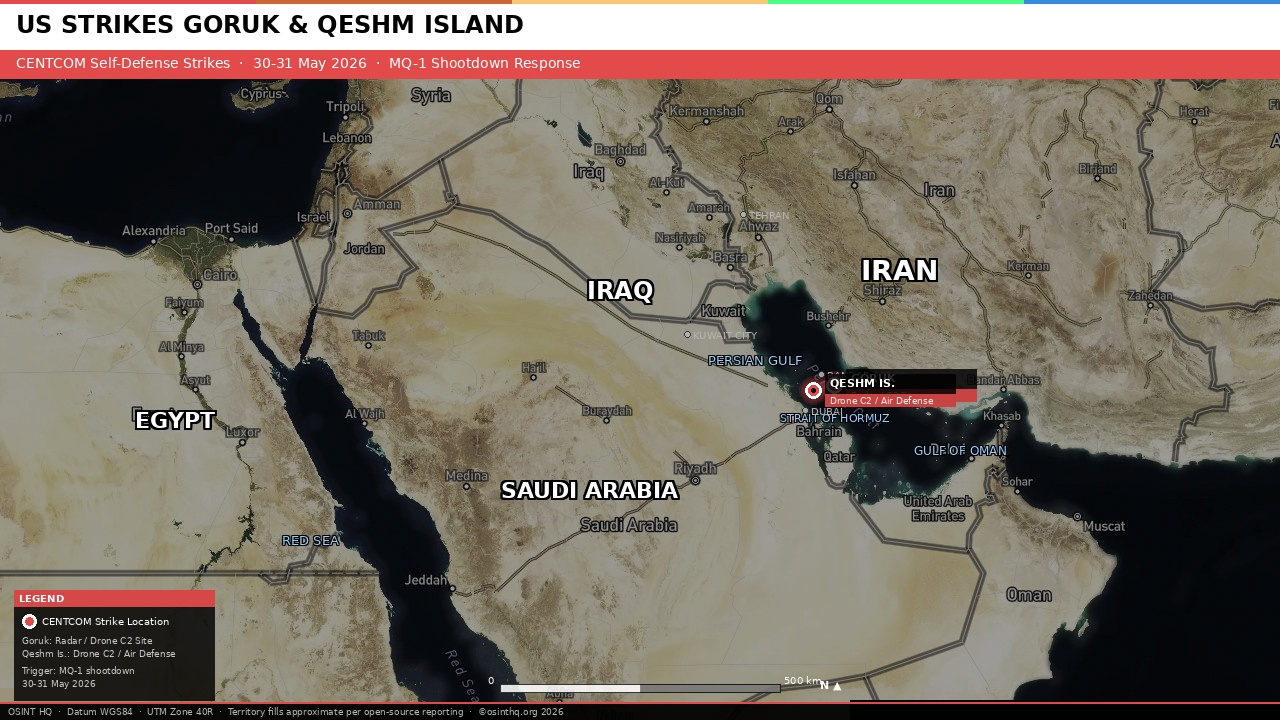
Strait of Hormuz region showing CENTCOM strike locations at Goruk (Hormozgan Province) and Qeshm Island, Iran, 30 to 31 May 2026. Strike positions are indicative areas per open-source reporting; exact GPS coordinates not publicly disclosed. Map: OSINT HQ / OSINT. Datum WGS84, UTM Zone 40R. ©osinthq.org 2026
| 📍 GORUK STRIKE ZONE, HORMOZGAN AREA ONLY Approximate Area Centre of indicative zone. Exact site not publicly disclosed. CENTCOM named “Goruk” as the Iran-side strike location. Closest gazetteer match is Garuk, Sirik County, Hormozgan Province. Specific radar and command-and-control site within the area not disclosed in the CENTCOM release. Source: Approximate per CENTCOM public release 31 May 2026; gazetteer reference Wikipedia / Garuk, Hormozgan | 📍 QESHM ISLAND, STRAIT OF HORMUZ PRECISE MGRS: 40R NV 82250 18200 26.7675°N 55.7725°E Island centroid. Qeshm is 1,491 km2 in area, located in the Strait of Hormuz. IRGC Naval Base is on the south-central shore. Specific CENTCOM target within the island not disclosed. Source: Wikipedia infobox, Qeshm Island article |
| 📍 GARUK (GORUK), SIRIK COUNTY INDICATIVE MGRS: 40R PV 12700 96100 26.5875°N 57.0933°E Town-level centroid. CENTCOM spelling is “Goruk”; Wikipedia gazetteer uses “Garuk.” Sirik County, Hormozgan Province. Approximately 60km east of Bandar Abbas and 200km east of Qeshm Island. Accuracy bound approx. 2km. Source: Wikipedia infobox, Garuk, Hormozgan article | 📍 BANDAR ABBAS, CROSS-CHECK REFERENCE PRECISE MGRS: 40R NV 77200 45000 27.1865°N 56.2808°E Regional capital and primary IRGC naval hub in Hormozgan Province. Reference point for MGRS grid orientation. Approximately 35km north-northwest of Qeshm Island. Source: GeoNames, Bandar Abbas |
SITREP Timeline : US-Iran Ceasefire Breakdown Sequence, April to June 2026
🔴 The CENTCOM Release
Measured and Deliberate: What CENTCOM Said, and What It Did Not
The CENTCOM public release, dated 31 May 2026 and issued from Tampa, Florida, is brief by the command’s recent standards. It runs to three short paragraphs. The operative sentence is this: US Central Command conducted self-defense strikes on Iranian radar and command-and-control sites for drones in Goruk, Iran and Qeshm Island this weekend. Two days, two named locations, one declared legal basis.
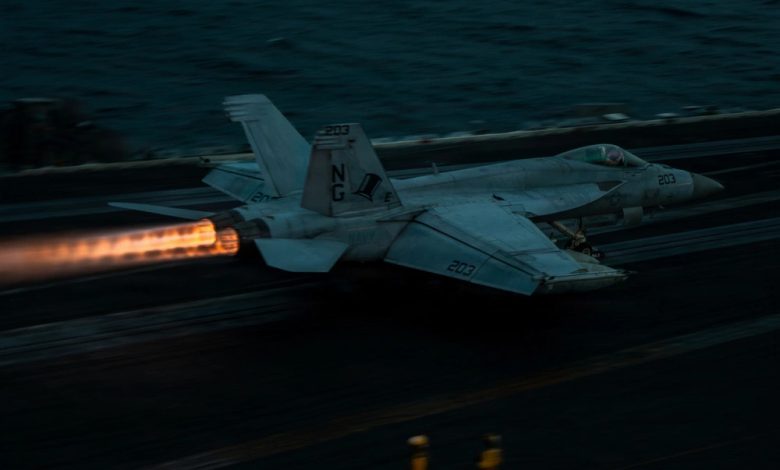
The causal chain CENTCOM presents runs as follows. Iran shot down a US MQ-1 drone operating over international waters. US fighter aircraft then eliminated Iranian air defenses, a ground control station, and two one-way attack drones assessed as posing clear threats to ships transiting regional waters. CENTCOM describes the strikes as measured and deliberate. No US service members were harmed. The command adds that it will continue to protect US assets and interests in response to unwarranted Iranian aggression during the ongoing ceasefire.
That last phrase, during the ongoing ceasefire, is doing significant legal and diplomatic work. It signals that CENTCOM frames its action as consistent with, not in violation of, the 8 April ceasefire. The legal argument is that the ceasefire covers offensive military operations but preserves the right of self-defense under Article 51 of the UN Charter. Iran’s reading, predictably, is the opposite: that kinetic US military action inside Iranian territory is itself the ceasefire violation, regardless of the triggering event.
🟡 The MQ-1 Shootdown
Two Contradictory Accounts, One Lost Drone, No Independent Verification
CENTCOM says the MQ-1 was operating over international waters when Iran shot it down. The IRGC, in a statement carried by IRNA (Iranian state media) on 31 May, says the drone entered Iranian territorial airspace with the intention of conducting hostile operations and was targeted by advanced air defence missiles. The IRGC characterised the aircraft as belonging to the US Army. The divergence on location, international waters versus Iranian territorial airspace, is not a minor definitional dispute. It is the hinge on which the entire legal and political argument turns.
The MQ-1 Predator is a surveillance and light strike platform that entered US service in the 1990s and is considered legacy technology by current standards. Its operational use in the Gulf theatre in 2026 is consistent with persistent maritime surveillance and, given the ongoing blockade, with monitoring IRGC naval activity near Qeshm Island and in the Khuran Strait. That it was flying close enough to Iranian territorial airspace to generate a genuine dispute over its position is itself noteworthy: the margins at the Strait of Hormuz are narrow, and the gap between international and territorial waters at certain points is a matter of a few nautical miles.
No neutral technical verification of the drone’s last recorded position has been published at time of writing. The US presumably holds telemetry. Iran may hold recovered debris, if the drone came down over Iranian-claimed territory. Until one or both are independently verified, the CENTCOM account and the IRGC account are, from an open-source intelligence perspective, formally equivalent in evidentiary weight. OSINT HQ treats the CENTCOM account as the primary record but does not present it as the definitive factual settlement of the location question.
🔵 Goruk and Qeshm
Two Strike Locations That Describe the Structure of the IRGC Drone Network
Qeshm Island, at approximately 40R NV 82250 18200 (26.7675°N, 55.7725°E), is the largest island in the Persian Gulf and one of Iran’s most strategically significant military positions. It physically dominates the northern approach to the Strait of Hormuz. The IRGC Naval Base on the island’s south-central shore gives the Guards direct, short-notice access to the shipping lanes. AllSource Analysis documented drone and missile infrastructure there as far back as 2012; the island’s role as what Al Jazeera has described as a component of Iran’s “underground missile cities” network has been widely covered since the 2026 war began.
Goruk, which CENTCOM spells as a single word, corresponds most closely to Garuk in Sirik County, Hormozgan Province, at approximately 40R PV 12700 96100 (26.5875°N, 57.0933°E), approximately 60 kilometres east of Bandar Abbas. Sirik County sits on the Iranian coast between the Strait of Hormuz and the Gulf of Oman, directly opposite the Omani coastline. Its geographic position makes it suitable for surveillance and one-way attack drone operations over international shipping lanes in both the Strait and the Gulf of Oman approaches. The CENTCOM designation of Goruk as a site for drone radar and command-and-control infrastructure is consistent with the coast’s general function in IRGC maritime operations doctrine.
The two-site profile, one on the island dominating the Strait and one on the mainland coast east of Bandar Abbas, is consistent with an overlapping drone coverage architecture: Qeshm handles operations in the western Strait and the Persian Gulf, while the Goruk facility handles eastern Strait and Gulf of Oman approaches. Striking both in a single weekend suggests CENTCOM targeted the network, not just the node that launched the drone that shot down the MQ-1.
US Central Command : Official Public Release, 31 May 2026
“CENTCOM will continue to protect US assets and interests in response to unwarranted Iranian aggression during the ongoing ceasefire.”
⚠ The IRGC Response
A Claimed Retaliatory Strike, A Warning, and a Regional Expansion
By Monday 01 June, Iran’s IRGC Aerospace Force issued a statement, carried by Iranian state media, claiming it had targeted the US airbase from which it said a strike on a telecommunications tower on Sirik Island, Hormozgan Province, had originated. The IRGC said the retaliatory operation destroyed pre-designated targets linked to that attack. It warned that any further US military action would produce a “completely different” response. The statement attributed responsibility to the “aggressor.” ⚠ Single-source: IRGC claim via Iranian state media, not independently confirmed at time of writing.
The Sirik Island telecommunications tower strike is a new incident thread that CENTCOM has not publicly acknowledged at time of writing. NBC News reported, citing its own sources, that Iran claimed a US attack on the tower preceded the IRGC’s Monday response. If accurate, this adds a third exchange to the weekend sequence: MQ-1 shootdown, CENTCOM strikes at Goruk and Qeshm, a US strike on Sirik Island infrastructure, then the IRGC airbase retaliation. Each step is contested between the two sides’ official accounts.
Separately, Kuwait’s General Staff announced on Monday that the country’s air defence systems were actively intercepting hostile missile and drone attacks. The Kuwaiti statement said any explosions heard by residents were the result of interception. Kuwait did not attribute the attacks by name. Iran International reported the incident in the same news cycle as the IRGC airbase claim. Whether the Kuwait attacks represent an IRGC decision to broaden pressure across the Gulf region, or an action by Iran-aligned Iraqi militias, is not currently resolvable from open sources.
🟢 The Negotiations Context
Strikes Inside Peace Talks: The Pattern of the 2026 Ceasefire
The weekend exchanges occurred against a backdrop of active, reportedly near-concluded US-Iran negotiations. On approximately 23 May, Trump said publicly that a deal to reopen the Strait of Hormuz was “largely negotiated” and would be announced shortly. He reported calling the leaders of Saudi Arabia, the UAE, Qatar, Pakistan, Turkey, Egypt, Jordan and Bahrain, as well as Israeli Prime Minister Benjamin Netanyahu, to finalise terms. By 27 May, PBS reported that negotiators had reached a tentative deal to extend the ceasefire by 60 days and begin nuclear talks.
Iran’s Foreign Ministry, for its part, described the two sides as simultaneously “very far and very close” to agreement, citing what it called conflicting US positions. Trump told Axios on the same weekend that there was a “50/50” chance of a deal or, in his phrasing, blowing them to kingdom come. The US Treasury Department simultaneously imposed new sanctions on Iran’s military oil sales arm, a move Iran called evidence of bad faith. This is the recurring structural feature of the 2026 ceasefire: negotiations and kinetic exchanges running in parallel, with each side framing its military actions as defensive and its diplomatic moves as sincere.
Trump said Monday, after the weekend strikes, that the US had held off from broader attacks on Iran while serious negotiations were underway. The phrasing is consistent with a deliberate calibration: preserve the diplomatic track while maintaining military pressure sufficient to respond to what CENTCOM classifies as Iranian aggression. From the Iranian side, conducting drone operations that provoke a US response while simultaneously negotiating a deal is also calibrated: it tests how far the US will escalate during talks, and preserves the IRGC’s domestic narrative that it is not capitulating.
Source Reliability Matrix
NATO grading: REL A (reliable) to F (unreliable). CRED 1 (confirmed) to 6 (cannot judge).
CRED 1
Official US military public release. Primary source for the self-defense strikes. Confirmed by multiple independent wires.
CRED 2
Independent Persian-language news outlet. Reliable on Iran-related developments. Corroborates CENTCOM strike and IRGC retaliation claim.
CRED 2
Established US news network. Adds the Sirik Island telecommunications tower thread and Iran’s claim of separate provocation. Consistent with Iran International reporting.
CRED 3
Iranian state media and IRGC-affiliated outlet. All IRGC claims labelled as assertions throughout. Tasnim is IRGC-affiliated; IRNA is Iranian state-run. Useful as primary record of the Iranian official position, not as independent verification.
CRED 1
Official Kuwaiti military statement. Confirms hostile inbound missile and drone attacks on Kuwait and active interception. Does not name attacker. Reported by Iran International.
OSINT HQ Assessment
Both sides are exchanging strikes while simultaneously claiming to negotiate in good faith; the ceasefire is a framework for calibrated escalation, not a halt to hostilities.
✓ What We Know
CENTCOM struck Iranian radar and drone command-and-control sites at Goruk (Hormozgan Province) and on Qeshm Island over the weekend of 30 to 31 May 2026. The stated trigger was the shootdown of a US MQ-1 drone; CENTCOM says it was over international waters. US fighter aircraft additionally destroyed Iranian air defenses, a ground control station, and two one-way attack drones. No US personnel were harmed. The IRGC claimed a retaliatory strike on a US airbase on 01 June. Kuwait confirmed active interception of hostile missile and drone attacks the same day.
? What We Do Not Know
Whether the MQ-1 was over international waters or Iranian territorial airspace at the moment of shootdown; no neutral technical verification published. The precise targets struck within Goruk and on Qeshm Island. Whether the IRGC retaliatory strike caused any damage to a US facility and which base was targeted. Whether the Kuwait attacks were IRGC-directed or Iran-aligned Iraqi militia operations. Whether the tentative 27 May ceasefire extension deal survives this sequence of exchanges or has been effectively abandoned by one or both sides.
☉ What To Watch
Whether CENTCOM publicly acknowledges or denies the Sirik Island telecommunications tower strike that Iran cites as the proximate cause of its Monday retaliation. Whether Trump announces a formal response or restraint to preserve the negotiating track. Whether Kuwait officially attributes its Monday interceptions. Whether the 60-day ceasefire extension framework announced 27 May is formally confirmed or publicly cancelled by either side in the coming 48 hours. Whether Gulf state partners, Saudi Arabia, the UAE, and Qatar, publicly push back on the escalation sequence to protect their own security environments.
Sources
- US Defends, Disables Threats in Response to Iranian Aggression, CENTCOM Official Release, 31 May 2026
- CENTCOM says it struck Iranian radar and drone sites, Iran International, 01 June 2026
- US says it struck Iranian military targets after drone shot in international waters; Iran claims attack on air base, NBC News, 01 June 2026
- US says it struck Iranian military targets in recent days after drone shot in international waters, Times of Israel, 31 May 2026
- IRGC says it struck base used in US attack on Sirik Island, Iran International, 01 June 2026
- US, Iran exchange strikes as Kuwait intercepts missile and drone attacks, Gulf Business, 01 June 2026
- Iran’s IRGC says it struck US airbase for Sirik Island strike; Kuwait under threat, The Week India, 01 June 2026
- Trump says Iran deal reopening Strait of Hormuz largely negotiated, CNBC, 23 May 2026
- US and Iranian negotiators reach tentative deal to extend ceasefire and start new nuclear talks, PBS NewsHour, 27 May 2026
- Garuk, Hormozgan, Wikipedia (coordinate reference for Goruk)
- Qeshm Island, Wikipedia (coordinate reference)
Editorial Verification
The CENTCOM strikes at Goruk and Qeshm Island are verified through the official CENTCOM public release of 31 May 2026 and corroborated by Iran International, NBC News, Times of Israel, Gulf Business, The Week India, and Al Jazeera live blog. The MQ-1 shootdown is confirmed by CENTCOM (over international waters) and asserted by the IRGC via Tasnim and IRNA (over Iranian territorial airspace); the IRGC account is labelled throughout as an assertion. The IRGC retaliatory strike on a US airbase is a single-source IRGC claim via Iranian state media; no independent confirmation of damage has been published at time of writing and is flagged purple throughout. The Sirik Island telecommunications tower strike cited by Iran is not confirmed by CENTCOM and is treated as unverified. Kuwait missile and drone interceptions are confirmed by the Kuwait General Staff statement, reported by Iran International. Negotiation status sourced from CNBC (23 May), PBS NewsHour (27 May), and NBC News (01 June).
Coordinates and map (v8): Qeshm Island centroid (PRECISE) sourced from Wikipedia infobox at 26.7675°N, 55.7725°E; MGRS 40R NV 82250 18200. Garuk / Goruk town centroid (INDICATIVE) sourced from Wikipedia infobox at 26.5875°N, 57.0933°E; MGRS 40R PV 12700 96100; accuracy bound approximately 2km. Bandar Abbas reference point (PRECISE) from GeoNames. Specific strike sites within Goruk and on Qeshm Island are not publicly disclosed and carry AREA ONLY treatment in coordinate cards; no MGRS is stated for those cards. Static map to be produced with PIL overlay script sb-map-overlay.py on a satellite base image. Third-party watermarks to be removed from base before overlay. Territory fills, front line, and strike markers are approximate per open-source reporting. No classified imagery used. No third-party watermarks appear in the published image.
MGRS datum: WGS84 / UTM Zone: 40R / Cross-check reference: Bandar Abbas 40R NV 77200 45000
All claims independently attributed and verified to open sources where possible.
Approved for Publication
Marcus V. Thorne
Lead Editor, OSINT HQ
©osinthq.org 2026
This article is for news and analysis purposes only. Based on publicly available news sources and military updates. All rights reserved. Not for commercial reuse without permission.