Zelensky proposes ceasefire in open letter to Putin as Ukraine strikes St. Petersburg during SPIEF
Bottom Line Up Front
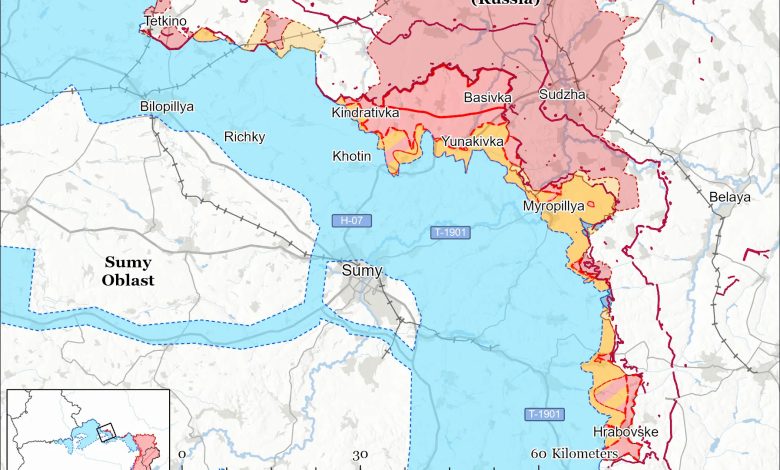
Ukrainian President Volodymyr Zelensky published an open letter to President Vladimir Putin on 4 June proposing a ceasefire along the current frontline and a face-to-face summit in a neutral country, to which the Kremlin replied that Zelensky was welcome to come to Moscow. Neither side made confirmed frontline advances, Russian forces launched 293 drones and one Iskander-M ballistic missile overnight, and the Russian Ministry of Defence demonstrated a new battle management information system that ISW assessed Moscow intends to export to partner militaries via the Center 2026 strategic exercise in September.
Key Judgments
The Kremlin will not accept Zelensky’s terms. Kremlin spokesman Dmitry Peskov’s response, that Zelensky could arrive in Moscow “at any time,” recycles Putin’s standing position that he will only meet to finalise an already-agreed deal. Zelensky’s letter explicitly ruled out Moscow as a venue and stipulated that the United States and European partners must be present. The two positions are structurally incompatible, and nothing in the 4 June exchange indicates movement on either side.
Ukrainian long-range strikes are successfully eroding the Kremlin’s capacity to stage economic credibility events. The oil terminal fire at St. Petersburg on 3 June produced black smoke visible from the SPIEF venue three kilometres away, disrupted Pulkovo Airport for the morning, and framed every photographic release from the forum’s opening day against a burning skyline. ISW confirmed that the St. Petersburg strike coincided with the forum opening and directly contradicted Moscow’s SPIEF narrative of domestic economic stability.
The new Russian battle management information system demonstrated by the Ministry of Defence on 4 June is assessed by ISW as intended for export to partner militaries through the Center 2026 exercise in September. The system’s capabilities and its degree of operational integration with forces currently fighting in Ukraine remain single-source and unconfirmed from independent channels.
293
Russian Drones, Overnight 3/4 June
264
UAVs Intercepted by Ukrainian Air Defence
1,000+
km Range of St. Petersburg Strike
0
Confirmed Frontline Advances, Either Side
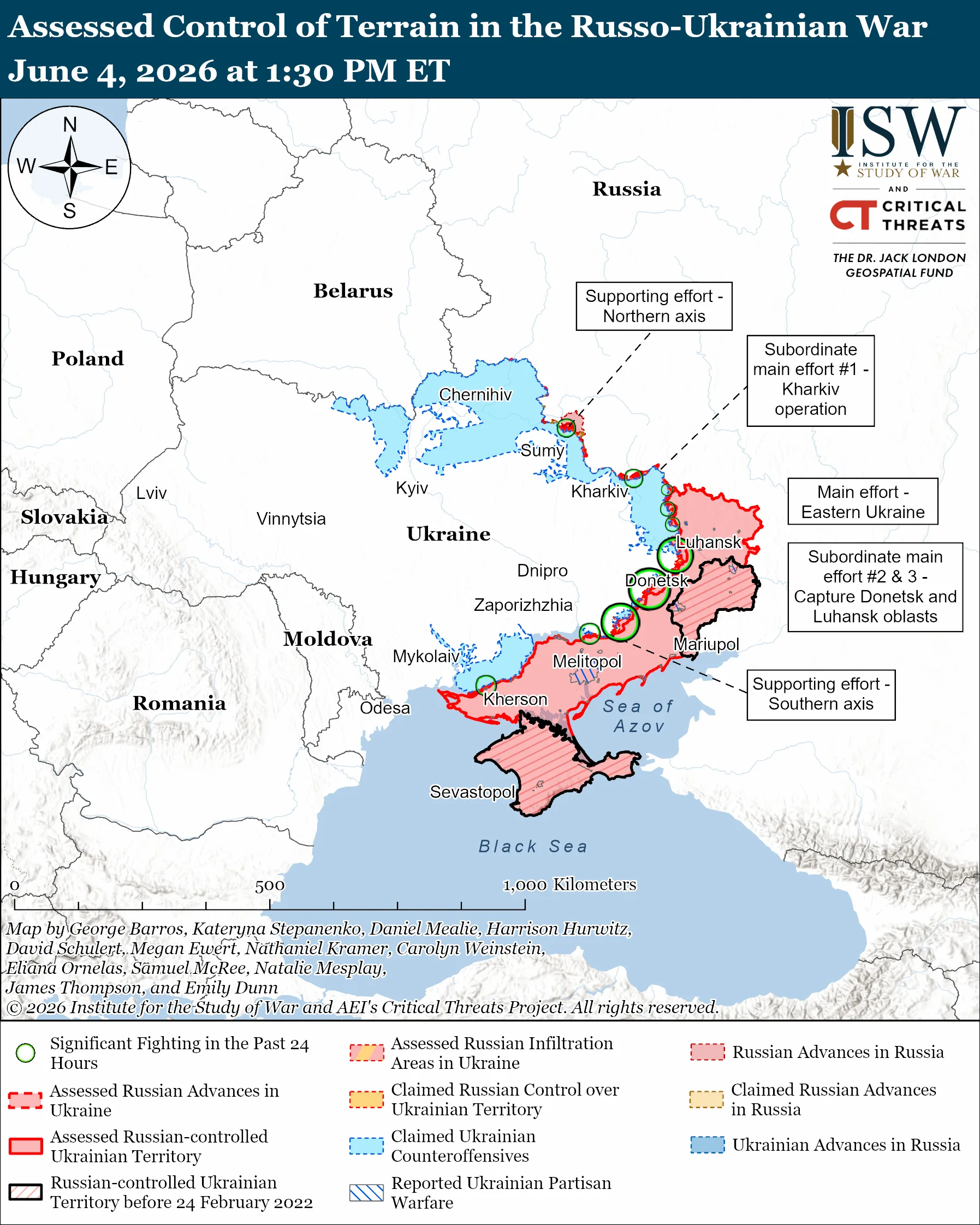
Assessed Control of Terrain, Russo-Ukrainian War, 4 June 2026 at 13:30 ET. Map: Institute for the Study of War and AEI’s Critical Threats Project. All rights reserved.
The Letter
Zelensky to Putin: Meet Me Outside Russia
The Office of the President of Ukraine released the letter at approximately 21:55 local time on 4 June. It was addressed formally to the President of the Russian Federation. The timing was deliberate: Ukrainian drones had struck the St. Petersburg oil terminal and the Russian Baltic Fleet corvette Boikiy at Kronstadt the previous morning, the day Putin opened SPIEF. Zelensky published the letter as that forum continued.
The core offer was an immediate ceasefire along the current frontline, a face-to-face bilateral summit in a neutral country, a full prisoner exchange as an opening act, and European and American participation in any formal talks that followed. Zelensky proposed Istanbul, the Vatican, or Switzerland as venues. He offered to meet as early as 5 June if Russia agreed to a ceasefire before the leaders’ meeting, or to set a fixed later date if it did not. American monitoring and mediation guarantees were named as conditions for any ceasefire period to hold.
The letter ran significantly longer than a diplomatic aide-memoire. Zelensky argued that nearly 13 of Putin’s 26 years in power had been spent in war against Ukraine. He cited Russian losses of over 30,000 troops in the preceding period and told Putin that Moscow lacked the financial resources to sustain indefinite domestic loyalty-buying. He warned that he had seen intelligence suggesting Russia was planning to continue the war into 2027 and 2028, and that Belarus was being drawn deeper into the conflict alongside preparations around Transnistria. “If you do not personally come to the conclusion that it is time to end this war,” he wrote, “Ukraine will continue fighting for its existence.”
The Kremlin responded the same evening. Peskov told state media that Putin had not yet been shown the letter but that Zelensky could come to Moscow “any time.” Putin’s position has been consistent since 2022: he will meet Zelensky to ratify an agreement already settled through intermediaries, not to negotiate one. He has not accepted a neutral venue. Direct addresses from Zelensky to Putin are rare; the gap since Russia’s full-scale invasion began in February 2022 is now more than four years, and months of United States-led shuttle diplomacy have not moved the parties toward an agreed framework.
St. Petersburg
Smoke Over SPIEF
The morning of 3 June was chosen carefully. As the first delegates arrived for the St. Petersburg International Economic Forum, Ukrainian drones hit the St. Petersburg oil terminal in Leningrad Oblast, one of the largest oil transshipment complexes on the Baltic Sea, and struck the corvette Boikiy in dry dock at the Kronstadt naval base. Zelensky confirmed both strikes on social media. Leningrad Oblast Governor Aleksandr Drozdenko said 50 drones were shot down over the region but did not address the terminal fires. Photographs distributed on the forum’s opening day showed SPIEF branding against a curtain of black smoke.
The drones covered more than 1,000 kilometres from the Ukrainian border, the same basic capability that has been striking oil refineries and logistics hubs across the Russian rear since March. ISW noted that the SPIEF attack extended a pattern of Ukrainian strikes on Russian oil and gas infrastructure and specifically contradicted the Kremlin’s preferred framing of the forum as a platform for projecting economic stability. Separately, CNN reported that two firefighters died at the oil terminal fire, attributed by regional authorities to debris from an intercepted drone. Pulkovo Airport delayed nearly 30 flights and diverted nine others. Putin had pruned the Victory Day parade in Moscow weeks earlier for fear of Ukrainian drone attacks; the SPIEF fire produced a similar result without requiring any alteration of the public programme.
On 4 June, the ISW assessment noted that Russian officials continued to ignore domestic economic problems at the forum. Ukrainian intelligence estimated that Russia was attempting to conceal an $80 billion budget deficit, that revenues had fallen by 40 per cent, and that 71 of Russia’s regions were running deficits. Fuel shortages, rising diesel prices, and coupon-based rationing have been reported in multiple regions, including Crimea. The forum continued to present a narrative of growth and stability. Independent economic commentary, including from Sberbank chief executive Herman Gref and Severstal owner Alexei Mordashov, indicated that ruble weakening and inflationary pressure were effectively unavoidable from their perspective inside the forum itself.
Battlefield and Overnight Strikes
No Ground Movement, 293 Drones Inbound
ISW confirmed no advances by either Russian or Ukrainian forces across the theatre on 4 June. On the overnight of 3 to 4 June, Russian forces launched 293 drones and one Iskander-M ballistic missile against Ukraine. The Ukrainian Air Force intercepted 264 of the 293 drones; 24 drones struck 11 locations, and falling debris was recorded at 12 sites. Russian strikes hit the Kherson region, Konotop in Sumy Oblast, and a critical infrastructure facility in Odesa Oblast, among other targets. The Kyiv region also saw strikes, with a fuel truck driver injured in an aerial attack.
On 4 June, Ukrainian forces continued their own long-range campaign. Targets struck inside Russia included a double strike on an oil depot in Pereyaslav in the Kyiv Region, energy facilities in Sarny and Lebedyn, and a locomotive depot in Snovsk as well as a seaport facility. Ukraine’s Unmanned Systems Forces Commander Robert Brovdi confirmed the hit on Boikiy at Kronstadt as part of the 3 June operation. A Russian Svetlyak-class border patrol ship in occupied Crimea was also reported struck in operations conducted on 3 and 4 June, per Ukrinform citing Ukrainian military reporting.
Russian casualty figures remain contested. Ukrainian military estimates put total Russian personnel losses since February 2022 at approximately 1,369,340, including roughly 1,300 killed or wounded in the 24 hours to 4 June. These figures are Ukrainian government reporting and are not independently verifiable. ISW also noted the Russian MoD’s demonstration of a new battle management information system, assessed as intended for deployment with international exercise partners during Center 2026, the strategic command-and-staff exercise scheduled for September. The system’s current operational status in Ukraine was not detailed in open sources.
Diplomatic Context
Hungary Drops Veto, EU Accession Moves
On 3 to 4 June, Hungary’s new Prime Minister Peter Magyar announced a comprehensive agreement with Kyiv on the expansion of linguistic, educational, cultural, and political rights for the ethnic Hungarian minority in Transcarpathia, effectively ending Budapest’s two-year block on Ukraine’s EU accession process. All 27 EU member states subsequently cleared the opening of Cluster 1 negotiations, the so-called Fundamentals cluster, with the Cypriot EU presidency expected to formally open the first chapters in mid-June. Ukraine’s Prime Minister Yuliia Svyrydenko confirmed the agreement on 4 June. The Hungarian-Ukrainian deal also followed Magyar’s government lifting Orban-era vetoes on European Peace Facility military reimbursements totalling 6.6 billion euros and reaching a separate agreement with the European Commission on 16.4 billion euros in previously frozen EU funds.
The EU accession development sits outside the frontline but carries strategic weight. Kyiv has treated the accession path as part of the broader argument that Ukraine’s future lies in Western institutions regardless of how the war ends. The accession opening coincides with the US House of Representatives passing the Ukraine Support Act, which allocated $8 billion in military financing and extended the Ukraine Security Assistance Initiative through 2027 while imposing additional sanctions on Russia. The bill passed as a rebuke to the White House’s posture on Russia policy, per Kyiv Post’s characterisation of the vote.
Against all of that, the Zelensky letter and Kremlin response on 4 June changed nothing on the ground. The letter was addressed to a leader who has told foreign mediators he expects to finalise terms, not negotiate them. Trump said a direct Putin-Zelensky meeting would be “great” but pushed both sides to compromise; no mechanism for compelling either side toward the Zelensky-proposed format is visible in the current diplomatic landscape. The strikes, the drones, and the frontline stalemate continued through the day and overnight.
OSINT HQ Assessment
The letter changes the optics. The Kremlin’s reply changes nothing else.
✓ What We Know
Zelensky published an open letter on 4 June proposing a ceasefire and bilateral summit in a neutral country. Peskov replied that Zelensky could come to Moscow. Neither Russia nor Ukraine advanced on the frontline. Russia launched 293 drones and one Iskander-M overnight; Ukrainian air defence intercepted 264. Ukrainian long-range strikes on 3 and 4 June hit the St. Petersburg oil terminal, the corvette Boikiy, energy and oil infrastructure across multiple Russian oblasts, and a seaport. ISW confirmed the SPIEF strike directly undermined Moscow’s economic stability narrative. All 27 EU member states cleared the opening of Ukraine’s accession Cluster 1 after Hungary lifted its veto. The US House passed the Ukraine Support Act at $8 billion.
? What We Do Not Know
Whether Trump will use the Zelensky letter as a basis for renewed pressure on Putin, or whether the White House treats it as a unilateral Ukrainian move outside the existing US-led framework. The capabilities and current deployment status of the Russian MoD’s new battle management system. Whether the SPIEF fuel and budget figures cited by Ukrainian intelligence represent the full scope of Russia’s fiscal position or are advocacy estimates. Whether any back-channel contact between Kyiv and Moscow preceded the letter or is running in parallel to it.
☉ What To Watch
Whether Putin responds publicly to the letter before SPIEF closes on 6 June. Whether Trump follows his “would be great” comment with any pressure on Moscow to accept a neutral venue. Whether the Ukrainian strike tempo on Russian energy infrastructure continues through the SPIEF period, and what cumulative effect that has on the forum’s messaging internationally. Whether the EU accession opening and the US House bill combine to shift Moscow’s calculus on the cost of continued war, or whether the Kremlin reads them as further justification for rejecting the Zelensky framework.
Sources
- ISW, Russian Offensive Campaign Assessment, 4 June 2026, Institute for the Study of War
- ISW Russian Offensive Campaign Assessment, June 4 2026, Kyiv Post, 5 June 2026
- Enough of the war: Zelensky throws down gauntlet to Putin in open letter, Kyiv Independent, 4 June 2026
- In open letter to Putin, Zelensky calls for meeting and ceasefire, France 24/AFP, 4 June 2026
- In open letter to Putin, Zelensky calls for meeting and ceasefire, The Moscow Times, 4 June 2026
- Ukrainian drones strike a St. Petersburg oil terminal ahead of Putin visit, NPR/AP, 3 June 2026
- Ukrainian drones strike St. Petersburg, hours before Putin’s Davos opens, CNN, 3 June 2026
- Ukraine strikes St. Petersburg oil terminal as Putin’s economic forum opens, Kyiv Independent, 3 June 2026
- Fresh satellite images show burning naval base and oil terminal in St. Petersburg, New Voice of Ukraine, 4 June 2026
- Russian authorities are concealing the country’s economic crisis at the St. Petersburg forum, Ukrainian National News (ISW relay), 4 June 2026
- Russia attacks Ukraine with Iskander missile and 293 UAVs, 264 downed by air defences, Ukrpravda, 4 June 2026
- 16 killed, 86 injured in Russian attacks across Ukraine over past day, Kyiv Independent, 4 June 2026
- Hungary drops EU veto to open new chapter in relations with Ukraine, Balkan Insight, 4 June 2026
- Hungary lifts veto on Ukraine’s EU accession, ending two-year deadlock, Euronews, 3 June 2026
- Hungary ends Ukraine arms blockade, unlocks 6.6bn EU funds, Kyiv Post, 2 June 2026
Editorial Verification
The Zelensky open letter is verified across Kyiv Independent, Kyiv Post, France 24/AFP, and The Moscow Times. Peskov’s “come to Moscow” response is verified via AFP/France 24 and Moscow Times citing Russian state media. The St. Petersburg oil terminal strike is cross-confirmed by NPR/AP, CNN, Kyiv Independent, and New Voice of Ukraine; two firefighter deaths at the terminal are reported by CNN/regional authorities and are single-source to that channel. The corvette Boikiy strike at Kronstadt is confirmed by NPR and New Voice of Ukraine citing the Ukrainian Unmanned Systems Forces commander Robert Brovdi. The 293 drone / one Iskander-M overnight attack is cross-confirmed by ISW (via Kyiv Post), Ukrpravda, and Kyiv Independent citing the Ukrainian Air Force. Russian MoD battle management system demonstration is single-source to ISW June 4 assessment relayed by Kyiv Post. The EU accession breakthrough is cross-confirmed by Balkan Insight, Euronews, and Kyiv Post. Ukrainian budget deficit figures cited at SPIEF are sourced to Ukrainian Foreign Intelligence Service claims reported by Ukrainian National News; these are Ukrainian government assertions and are not independently confirmed. All frontline engagement and casualty figures from Ukrainian official sources are not independently verifiable.
©osinthq.org 2026
This article is for news and analysis purposes only. Based on publicly available news sources and military updates. All rights reserved. Not for commercial reuse without permission.