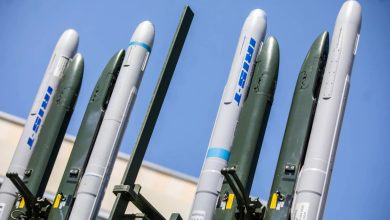
Drone Hits Zaporizhzhia Turbine Hall Russia Claims Ukraine, Kyiv Denies, IAEA Seeks Access
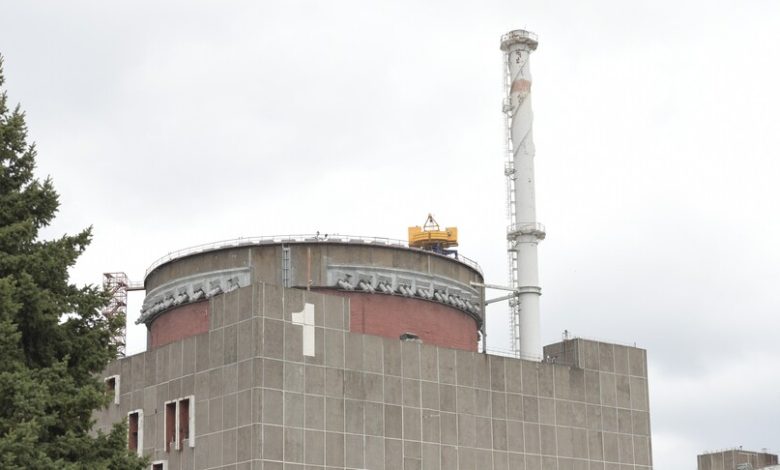
Threat Level Assessment
LEVEL 4 OF 5, SERIOUS
Bottom Line Up Front
A combat drone struck the turbine hall of Power Unit 6 at the Zaporizhzhia Nuclear Power Plant on the afternoon of 30 May 2026, blowing a hole in the building’s outer wall, Russia’s state nuclear corporation Rosatom asserted. Rosatom claimed the drone was fiber-optic guided, characterised the strike as the first deliberate attack on core nuclear plant equipment in the history of the facility, and attributed it to Ukraine. The Ukrainian military flatly denied responsibility, accused Russia of disinformation and nuclear blackmail, and stated Ukraine holds no fiber-optic drones with the range to reach the plant. The IAEA, which has a resident team at the plant, confirmed it was informed of a drone strike on a turbine building and said its experts requested access to inspect the damage. A second Reuters wire, separate from the turbine hall report, described drones hitting the plant’s training centre roof on the same day.
Key Judgments
A drone detonated inside or against the turbine hall of Unit 6 at ZNPP on 30 May 2026. This is confirmed by three independent sources: Rosatom’s public statement, the IAEA’s confirmation that its resident team was informed of a drone strike on a turbine building and requested access, and the wider multi-outlet pickup of the Reuters wire. The structural fact of the strike is not in dispute.
Attribution to Ukraine is unconfirmed. Rosatom asserts Ukrainian responsibility and claims fiber-optic guidance as the proof of deliberate intent. Ukraine’s Southern Defense Forces deny the strike entirely, say no evidence has been provided, and state Ukraine possesses no fiber-optic drone with the range to reach ZNPP from Ukrainian-held territory. Reuters stated it could not independently verify the Russian report. No wreckage, no flight path data, no independent technical analysis has been published.
Whatever the drone’s origin, the 30 May incident represents an escalation in the pattern of UAV activity at ZNPP, which has accelerated markedly since early May 2026. The IAEA had already warned that increased drone activity near the site intensified accident risk, and the plant had suffered a 12-hour communications blackout on 27 May in violation of IAEA nuclear safety principles. The strike on a turbine hall, even without damage to primary equipment, brings UAVs inside the plant’s structural envelope in a way that previous incidents near the perimeter did not.
2
Separate Strikes, 30 May
6
VVER Reactors, ZNPP
0
Radiation Anomalies Reported
12h
Comms Blackout, 27 May
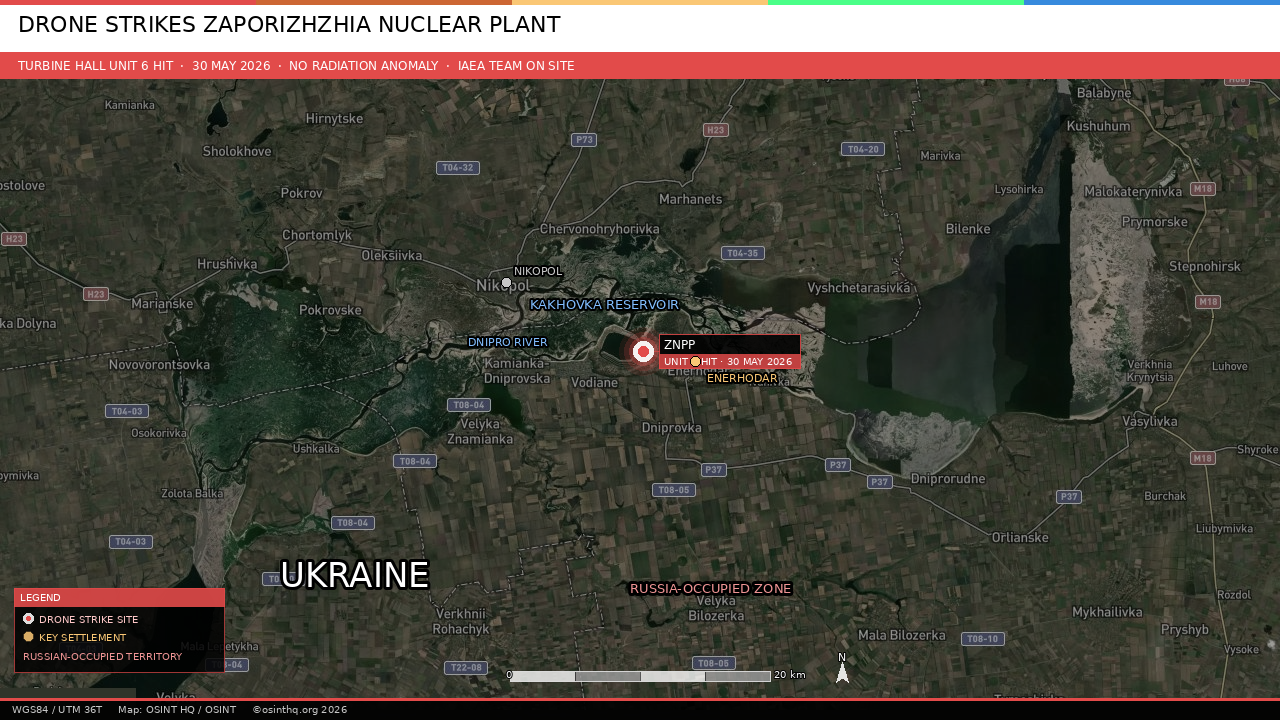
Zaporizhzhia Nuclear Power Plant, Enerhodar, Zaporizhzhia Oblast. Site of 30 May 2026 drone strike on turbine hall of Unit 6 and separate drone strike on training centre. Russia has occupied the plant since March 2022. Locations approximate per open-source reporting as of 30 May 2026. Map: OSINT HQ / OSINT. Datum WGS84, UTM Zone 36T. ©osinthq.org 2026
📍 Zaporizhzhia NPP Main Site
PRECISE
MGRS: 36T XT 19309 62872
47.5083°N 34.5844°E
Europe’s largest nuclear power plant. Six VVER-1000 reactors. Under Russian control since March 2022. Currently shutdown, requiring external power for cooling systems.
Source: Wikipedia infobox, cross-referenced GeoNames
📍 Unit 6 Turbine Hall Strike
AREA ONLY
Approximate Area
Centre of indicative zone. Exact sub-site not publicly disclosed.
Turbine hall of Unit 6 within ZNPP perimeter. Rosatom reported hole in outer wall, no damage to primary equipment. Exact coordinates within the 104-hectare site not disclosed by Rosatom or Reuters.
Source: Approximate per Rosatom and Reuters; sub-site coordinates undisclosed
📍 Training Centre Strike
AREA ONLY
Approximate Area
Centre of indicative zone. Exact sub-site not publicly disclosed.
Training centre roof struck by drones on 30 May; reported approximately 300 metres from a reactor unit. Houses the plant’s full-scale reactor hall simulator. Exact coordinates not disclosed.
Source: Approximate per Reuters wire and Russian-installed plant administration, 30 May 2026
📍 Enerhodar City Centre
PRECISE
MGRS: 36T XT 24707 61935
47.4989°N 34.6558°E
Purpose-built nuclear city on the southern bank of the Kakhovka Reservoir. ZNPP lies approximately 5 kilometres west-northwest of the city centre. Cross-check reference for MGRS grid orientation.
Source: Wikipedia infobox (Enerhodar article)
SITREP Timeline : ZNPP Incident Pattern, March 2022 to May 2026
🔴 The Turbine Hall Strike
A Drone Inside the Perimeter, A Hole in the Wall, and a Claim That Cannot Currently Be Verified
On the afternoon of 30 May 2026, a drone detonated inside or against the turbine hall building of Power Unit 6 at the Zaporizhzhia Nuclear Power Plant, situated at grid reference 36T XT 19309 62872 (47.5083°N, 34.5844°E) on the southern shore of the Kakhovka Reservoir in Zaporizhzhia Oblast. Russia’s state nuclear energy corporation Rosatom, in a statement from its Director General Alexey Likhachev, reported that the explosion tore a hole in the outer wall of the turbine hall but caused no damage to the unit’s primary equipment. Radiation levels at the plant remained normal, and no operational violations were recorded.
Likhachev’s statement went considerably further than a damage report. He characterised the event as the first deliberately targeted attack on core nuclear power plant equipment resulting in structural damage in the history of the facility, and framed the fiber-optic guidance system as the decisive proof of deliberate intent. Fiber-optic controlled drones are, by design, immune to electronic jamming and GPS spoofing; a drone following a physical cable to its target cannot, in principle, be deflected by electronic countermeasures or navigate by accident to the wrong location. That is the logic of Rosatom’s attribution argument. The problem is that the argument rests entirely on Rosatom’s own characterisation of the wreckage, and no independent party has examined the recovered drone or confirmed the fiber-optic claim.
Reuters, the primary Western wire on the turbine hall story, cited the Rosatom statement directly and noted that Reuters could not independently verify the report. The IAEA, which has a resident monitoring team at the plant under the terms of its ongoing mission, confirmed in a social media post that it had been informed of a drone strike on a turbine building and that its experts had requested access to the affected building to conduct a first-hand assessment. That IAEA confirmation is independent of Rosatom. It places a drone detonation at the turbine building. It does not address origin or guidance system.
🟡 Ukraine’s Denial
Southern Defense Forces Issue a Flat Rejection and Turn the Attribution Logic Back on Russia
Ukraine’s Southern Defense Forces responded to Rosatom’s claims with a formal denial, stating the Ukrainian Defense Forces did not strike Power Unit 6 at the Zaporizhzhia Nuclear Power Plant. The statement, carried by the Kyiv Independent, went beyond a simple denial. The military accused Russia of deploying the plant as an instrument of nuclear blackmail, said the reports spread by occupation resources constituted an attempt to discredit Ukraine and conceal Russia’s own actions, and specifically challenged the evidential basis of Rosatom’s claim. Russia, the statement noted, produced no photo or video evidence to support its version of events.
The fiber-optic range argument is substantive. Fiber-optic drones are, by their physical nature, limited in operational range by the length of cable they can carry on their spool. The technology has been documented on the Ukrainian battlefield primarily as a short-range solution to GPS jamming in close-contact infantry engagements, used by both sides. ZNPP is located inside Russian-controlled territory; the nearest Ukrainian-held positions are separated from the plant by the width of the Dnipro River and contested front-line ground. Ukraine argues this geometry makes a fiber-optic strike from Ukrainian-held territory physically impossible given current documented Ukrainian fiber-optic drone ranges.
That argument is not conclusive. It assumes current documented ranges reflect all Ukrainian capability. Russia could also be describing a different guidance type loosely as fiber-optic, or misidentifying wreckage. Alternatively, the drone could have launched from a position inside Russian-held territory for reasons unconnected to the Ukrainian military. The honest position is that without independent examination of the wreckage, the guidance system claim cannot be confirmed or dismissed, and attribution remains open.
Alexey Likhachev : Director General, Rosatom : 30 May 2026
“Today we are one step closer to an incident that could highly likely affect even those living far beyond the borders of Russia and Ukraine, who still believe they are completely safe.”
🔵 The IAEA and the Second Strike
Grossi Calls Attacks “Playing With Fire.” A Separate Reuters Wire Describes Drones at the Training Centre.
IAEA Director General Rafael Grossi responded publicly on 30 May, describing the turbine building strike as deeply concerning and warning that attacking nuclear facilities is “like playing with fire.” Grossi’s statement through Xinhua confirmed that the IAEA had been informed of the drone strike by the ZNPP management, that a hole had been caused in the turbine building’s wall, and that the agency’s resident team had formally requested access to inspect the damage first-hand. The CGTN report citing the IAEA noted the incident would mark the first drone attack within the perimeter of ZNPP since strikes were reported in April 2024, when drones hit multiple structures including the dome of reactor Unit 6.
Running in parallel on the same day, Reuters published a separate wire reporting that Ukrainian drones had struck the roof of the ZNPP training centre, approximately 300 metres from a reactor unit. This report was sourced to the Russian-installed administration of the plant via a Telegram statement, not to Rosatom directly, and Reuters again stated it could not independently verify the claim. The training centre reportedly houses the world’s only full-scale simulator of a reactor hall, described by the plant’s administration as a facility critical for staff training. Radiation levels remained normal after this incident also, and no casualties were reported.
Whether the turbine hall and training centre incidents represent a coordinated two-strike sequence or coincidental separate events on the same day is not established by available reporting. The two Reuters wires treat them as separate stories with separate sourcing. The cumulative effect, however, is a picture of two drone impacts at Europe’s largest nuclear facility on a single afternoon, with IAEA monitoring of both, no radiation anomalies, and no independent confirmation of the attackers’ identity in either case.
⚠ Medvedev’s Escalation Rhetoric
A Chornobyl Threat and the Question of Symmetrical Strikes on Nuclear Infrastructure
Russia’s former president and current deputy Security Council chairman Dmitry Medvedev, long documented as Moscow’s primary conduit for escalatory nuclear messaging, issued a statement following the Rosatom claims warning of a “new Chornobyl” scenario if Ukraine were to destroy a reactor hall or engine room at ZNPP. Medvedev asserted that Russia could respond with symmetrical strikes on Ukrainian nuclear power plants, and extended the implicit threat to nuclear plants in NATO member states. The Kyiv Independent, in its coverage of the denial, flagged Medvedev’s intervention as an example of nuclear blackmail, noting that the statement appeared rapidly, building on unverified Rosatom claims.
Medvedev’s statements are treated by Western analysts and Ukrainian officials as a consistent pattern of strategic intimidation rather than operational doctrine, but they carry non-trivial significance in a week when drone strikes are being reported inside ZNPP’s perimeter. The threat of symmetrical strikes on NATO nuclear plants, if ever acted upon, would implicate Article 5 of the North Atlantic Treaty and fundamentally transform the diplomatic character of the war. The fact that Medvedev deployed this language hours after an unverified Rosatom claim, and before IAEA access to the turbine hall had been granted, illustrates the information operations dimension of every incident at the plant.
The broader context is deteriorating. In the three days before the 30 May strikes, the ZNPP had suffered a 12-hour communications blackout on 27 May, its longest since the full-scale invasion, which violated IAEA principle seven requiring reliable external communication. IAEA had warned in May 2026 that intensified drone activity near Ukrainian nuclear sites was increasing accident risk. A drone struck the plant’s external radiation monitoring laboratory earlier in May. The May 30 turbine hall strike, whatever its origin, is therefore not an isolated event but the latest point in a trend that the IAEA has been flagging with increasing urgency for weeks.
Source Reliability Matrix
NATO grading: REL A (reliable) to F (unreliable). CRED 1 (confirmed) to 6 (cannot judge).
CRED 2
Primary wire. Sourced to Rosatom statement. Reuters explicitly stated it could not independently verify.
CRED 1
Independent of Rosatom. IAEA confirms drone struck turbine building and team requested access. The structural fact of the strike is confirmed by this source.
CRED 2
Turkish state wire. Sourced to Likhachev statement. Carries full Likhachev quotes not excerpted in the Reuters version.
CRED 1
Independent Ukrainian outlet. Carries full Southern Defense Forces denial statement with direct link to original Facebook post. Interest in the story is clear but reporting is straight and caveated.
CRED 3
Primary claimant and interested party. Controls the site and the information environment around it. Attribution and guidance-system claims are Rosatom assertions only; no independent corroboration available at time of writing.
OSINT HQ Assessment
A drone reached the turbine hall of Unit 6. That is confirmed. Everything Russia is asserting about who sent it, and how, is unverified. The pattern at ZNPP in May 2026 is the more important story: the plant is being approached, the IAEA’s safety threshold is being tested, and the communications blackout three days earlier suggests the site is already operating in a degraded safety posture.
✓ What We Know
A drone detonated at the turbine hall of ZNPP Power Unit 6 on the afternoon of 30 May 2026. A hole was made in the outer wall. No damage to primary equipment. No radiation anomalies. The IAEA independently confirmed the incident and requested building access. A second drone incident at the training centre roof occurred on the same day, approximately 300 metres from a reactor unit. ZNPP had a 12-hour comms blackout three days before the strike. Ukraine formally denied responsibility for the turbine hall strike. Russia produced no photographic or video evidence for public release at time of publication.
? What We Do Not Know
The origin of the drone or drones. Whether the guidance system was fiber-optic as Rosatom asserts. Whether the turbine hall and training centre incidents were coordinated or coincidental. Whether the IAEA team was granted access and what they found. The sub-site coordinates within the 104-hectare plant perimeter. Whether Medvedev’s NATO nuclear plant threat represents an operational signal or standard escalation rhetoric. Whether any Ukrainian capability gap on fiber-optic drone range actually forecloses Ukrainian responsibility, given the possibility of undisclosed longer-range systems or launch from Russian-held territory by non-state actors.
☉ What To Watch
Whether the IAEA publishes a formal update confirming or qualifying the turbine hall damage assessment after its team gains access. Whether any wreckage or drone component analysis becomes publicly available. Whether Rosatom releases imagery to support the fiber-optic attribution claim. Whether the tempo of drone incidents at ZNPP continues to increase through June 2026. Whether the comms blackout of 27 May is treated by the IAEA as a formal violation triggering a new protocol review. Whether the diplomatic response from non-belligerent nuclear states (France, UK, US) moves beyond standard concern statements to any institutional mechanism.
Sources
- Russia says Ukrainian drone hit turbine hall at Zaporizhzhia nuclear plant, Anadolu Agency (Elena Teslova), 30 May 2026
- Russia’s Rosatom Says Ukrainian Drone Struck Zaporizhzhia Nuclear Plant, Reuters via US News (Anastasia Lyrchikova / Felix Light), 30 May 2026
- Kyiv denies Russia’s claims of Ukrainian drone strike on Zaporizhzhia nuclear plant, Kyiv Independent (Abbey Fenbert), 30 May 2026
- IAEA chief voices concern over reported drone strike at Zaporizhzhia Nuclear Plant, Xinhua, 30 May 2026
- Ukraine drones hit training centre at Zaporizhzhia nuclear plant, Russian management says, Reuters via AOL (Lidia Kelly), 30 May 2026
- Zaporizhzhia Nuclear Power Plant, Wikipedia (coordinates sourcing, infobox)
Editorial Verification
The structural fact of the turbine hall drone strike is verified through two independent sources: Reuters wire (sourced to Rosatom) and the IAEA statement via Xinhua (independent of Rosatom, confirmed by IAEA resident team). The training centre incident is verified through a separate Reuters wire sourced to the Russian-installed plant administration. All Rosatom-origin claims, including attribution to Ukraine, the fiber-optic guidance assertion, and the characterisation of the strike as historically unprecedented, are labelled as Russian assertions and have not been independently verified. Reuters explicitly stated it could not independently verify the Russian reports in both wires. Ukraine’s flat denial is sourced to the Ukrainian Southern Defense Forces official statement, published in full by the Kyiv Independent, which linked to the original Facebook post. Medvedev’s escalation rhetoric is attributed to the Kyiv Independent’s reporting. No wreckage, imagery, or independent technical analysis of the guidance system was available at time of publication.
Coordinates and map (v8): ZNPP main site (36T XT 19309 62872, 47.5083°N, 34.5844°E) is PRECISE, sourced from Wikipedia infobox cross-referenced against GeoNames. Enerhodar city centre (36T XT 24707 61935) is PRECISE, sourced from Wikipedia infobox. The turbine hall of Unit 6 and the training centre are AREA ONLY: both are within the ZNPP 104-hectare perimeter, but exact sub-site coordinates have not been publicly disclosed by any party and are not derivable from current open-source reporting. No MGRS is shown for these sub-sites. Map pending upload by editor. Static map to be produced with PIL overlay script sb-map-overlay.py on a satellite base image. Third-party watermarks to be removed from base before overlay. No classified imagery used.
MGRS datum: WGS84 / UTM Zone: 36T / Cross-check reference: Enerhodar city centre 36T XT 24707 61935
All claims independently attributed and verified to open sources where possible.
Approved for Publication
Marcus V. Thorne
Lead Editor, OSINT HQ
©osinthq.org 2026
This article is for news and analysis purposes only. Based on publicly available news sources and military updates. All rights reserved. Not for commercial reuse without permission.