Hormuz Deal Outlined But Unsigned US and Iran Disagree on What the 14-Point MOU Actually Says

Threat Level Assessment
LEVEL 3 OF 5, DEVELOPING
Bottom Line Up Front
The United States and Iran have outlined a 14-point memorandum of understanding to extend the 8 April ceasefire by 60 days and reopen the Strait of Hormuz, but the agreement has not been signed and both sides are publicly offering conflicting accounts of its content. As of 25 May, Trump has told his negotiators not to rush, the US naval blockade remains in full force, and the nuclear file is explicitly excluded from the initial framework by Tehran while Washington insists it remains on the table. The deal, if signed, would demine and reopen the strait, allow Iran to sell oil under partial sanctions relief, and defer nuclear terms to subsequent talks; if it collapses, no mechanism exists to prevent renewed military escalation.
Key Judgments
A framework agreement exists and has been acknowledged by both sides. Iran's Foreign Ministry spokesman confirmed a 14-point MOU is being drafted. A US official told the Wall Street Journal that Washington has agreed to provide Tehran economic breathing room. Trump himself stated on 23 May that a deal had been "largely negotiated." These parallel confirmations from adversarial parties constitute the strongest available corroboration short of a signed text.
The nuclear file is not resolved and its status inside the MOU is the central point of failure. The US is publicly insisting Iran accept uranium transfer or suspension. Iran's Foreign Ministry has stated unambiguously that the nuclear issue is not part of the initial framework. This contradiction is not a negotiating posture for external audiences; it reflects a genuine unresolved clause. If Washington and Tehran cannot agree on what the 14-point document says before signing, the document cannot be signed.
Whether Republican opposition inside Washington will materially constrain Trump's ability to sign. Senators Roger Wicker and Ted Cruz have publicly warned against the deal and described a 60-day extension as a "disaster." Trump's response was to attack critics as "losers." Whether domestic political noise represents a hard constraint on the White House or a manageable complication is not yet determinable from open sources.
100+
Ships Redirected by Blockade
60
Day Ceasefire Extension Proposed
14
Points in Draft MOU Framework
~20%
Global Oil Supply via Hormuz in Peacetime
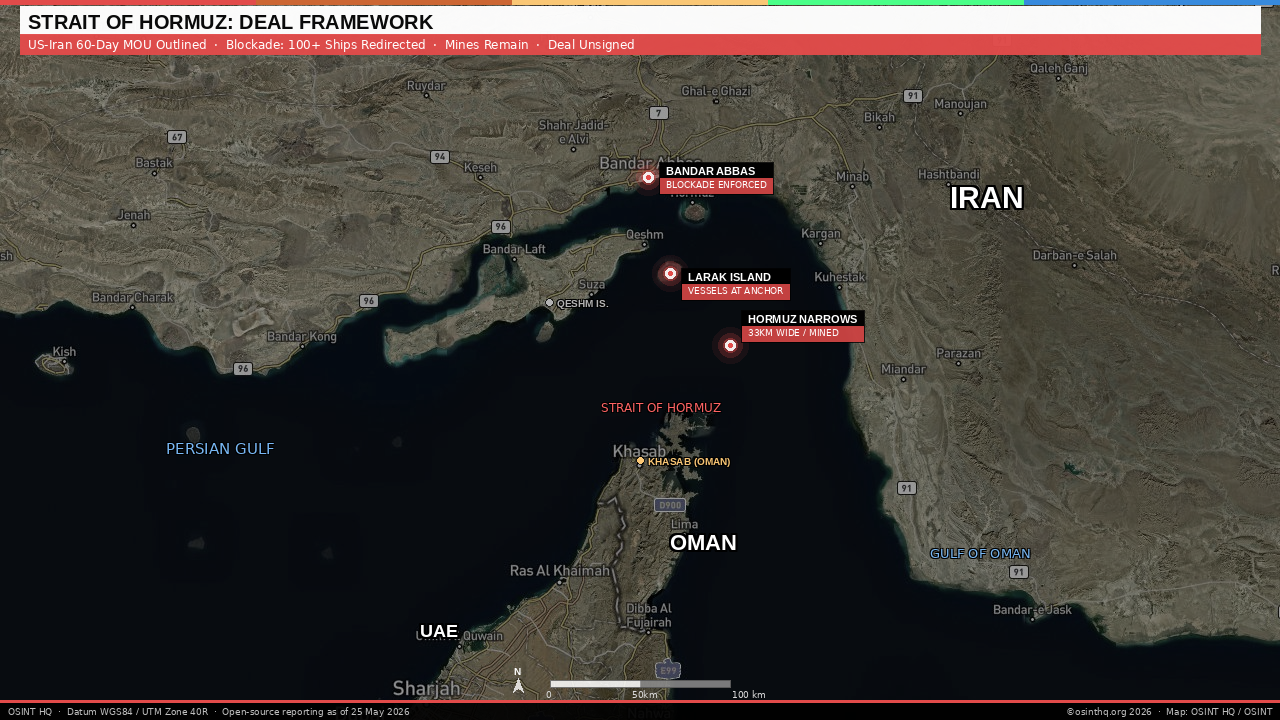
Strait of Hormuz narrows showing key anchorage and port locations relevant to the US naval blockade and ceasefire negotiations, 25 May 2026. Territory fills approximate per open-source reporting. Map: OSINT HQ / OSINT. Datum WGS84, UTM Zone 40R. ©osinthq.org 2026
📍 Strait of Hormuz Narrows
PRECISEMGRS: 40RCT 62000 35000
26.5667°N 56.2500°E
Centre of the strait narrows, the focal point of the US naval blockade and proposed demining under the MOU. Width approximately 33km at narrowest.
Source: GeoNames gazetteer / Wikipedia infobox
📍 Bandar Abbas, Iran
PRECISEMGRS: 40RDU 05500 74000
27.1833°N 56.2833°E
Iran's primary port on the strait. Focal point of US naval blockade enforcement. Commercial vessels visible at anchor in AP reporting as of 4 May 2026.
Source: GeoNames gazetteer / Wikipedia infobox
📍 Larak Island, Iran
PRECISEMGRS: 40RCT 90000 70000
26.8500°N 56.3667°E
Iranian island at the strait entrance where blockade-redirected vessels have been reported at anchor. Referenced in Times of Israel reporting from 24 May 2026.
Source: GeoNames gazetteer
📍 Khasab, Musandam Peninsula, Oman
PRECISEMGRS: 40RCT 40000 05000
26.3833°N 56.3500°E
Oman's Musandam port. Iranian state media accounts claim the MOU would place strait governance under Iran-Oman joint authority, giving Tehran effective control of the southern strait approach.
Source: GeoNames gazetteer / AFP reporting
SITREP Timeline : Hormuz Blockade and Diplomatic Track, Feb to May 2026
🔴 The Framework
A 14-Point Document That Both Sides Have Described and Neither Has Published
At the narrows of the Strait of Hormuz (MGRS 40RCT, centred on approximately 26.5667°N, 56.2500°E), the physical geography has not changed since 28 February. The channel remains around 33 kilometres wide at its tightest point. What has changed, over nearly three months of blockade, war, ceasefire, and renewed blockade, is the diplomatic architecture around it. As of 25 May, the United States and Iran are further along that architecture than at any prior point since the war began, but they have not reached an agreement, and the terms they are each describing publicly diverge sharply.
The document at the centre of the current discussion is a 14-point memorandum of understanding. Iranian Foreign Ministry spokesman Esmaeil Baqaei confirmed its existence on state television on 23 May, describing it as "a kind of framework agreement" and noting a "trend toward rapprochement." The MOU has also been described in US official briefings to Axios and the Wall Street Journal. Neither government has published the text. The gap between what each side says the document contains is the operational intelligence question.
On the US account, per a senior official briefed to the Wall Street Journal on 24 May, Washington has agreed to provide Tehran's economy with "breathing room" but has not committed to releasing frozen Iranian assets or lifting sanctions outright. In exchange, Iran has accepted "in principle" the idea of transferring its stockpile of enriched uranium to a third country, subject to further negotiation. Secretary of State Marco Rubio, speaking in New Delhi, described the US position as requiring Iran to stop pursuing a nuclear weapon, reopen Hormuz without tolls, and hand over its enriched uranium. "This problem will be solved, one way or the other," Rubio said.
⚠ The Iranian Account
Tehran's Version Includes Lebanon, Frozen Assets, And Joint Hormuz Control With Oman
Al Jazeera senior correspondent Ali Hashem, citing sources with access to the Iranian side of the talks, published a substantially different picture of what the proposed deal contains. In the Iranian account, the agreement would include a complete end to hostilities covering Lebanon as well as the Iran theatre; the release of billions of dollars in previously blocked Iranian funds; the lifting of the US naval blockade and restoration of Iranian oil exports; and the withdrawal of US forces from the region. US officials have not confirmed any of these elements.
The most strategically significant claim in the Iranian account is the governance of the strait itself. Iranian state media has reported that the agreement would leave the Strait of Hormuz under Iranian control in cooperation with Oman, as the two coastal states. Baqaei said explicitly on Tasnim News Agency that "the Strait of Hormuz has nothing to do with the US" and that "a mechanism should be defined between us and Oman as coastal countries." This framing would, if accurate, give Iran more strategic influence over the waterway after the agreement than it held before the war began.
The nuclear dimension shows the same inversion. While Washington describes Iran as having accepted uranium transfer in principle, Tehran's Foreign Ministry is explicit that the nuclear file is not part of the initial framework. "At this stage, we will not discuss the details of the nuclear issue," Baqaei told state television on 23 May. "We have decided to prioritize an urgent issue for all of us: ending the war on all fronts, including Lebanon." The nuclear question, in the Iranian framing, is relegated to a separate, subsequent negotiation. A senior Iranian source cited by Reuters on 24 May directly denied that Tehran had agreed to hand over its enriched uranium stockpile.
Nicole Grajewski, Assistant Professor, CERI Sciences Po : The Maritime Executive, 24 May 2026
"The ceasefire and broader de-escalation measures appear intended for near-term implementation, while the main sources of contention were pushed into a separate 30-60 day negotiation track. That structure is important because it pushes some of the hardest questions into less visible side documents while still allowing both sides to announce a political breakthrough."
🟡 Trump's Pause
The President Pulls Back From an Announcement His Own Administration Signalled Was Imminent
Saturday 23 May produced two contradictory signals from the White House within hours. In the morning, Trump said on TruthSocial that an agreement had been "largely negotiated." By Sunday 24 May, the posture had shifted. Trump posted that he had "informed my representatives not to rush into a deal," adding that "time is on our side" and that "the Blockade will remain in full force and effect until an agreement is reached, certified, and signed." NPR reported the Sunday post as deliberately dampening expectations for an announcement that had been publicly framed as imminent by administration officials the day before.
The proximate cause of the deceleration appears to be Republican pushback inside Washington. Senators Roger Wicker and Ted Cruz, along with former Secretary of State Mike Pompeo, publicly attacked the reported terms over the 23 to 24 May weekend. Pompeo described the deal as paying "the IRGC to build a WMD program and terrorize the world." Wicker wrote that the rumoured 60-day ceasefire "would be a disaster" and that "everything accomplished by Operation Epic Fury would be for naught." Trump's response was to dismiss critics as "losers," but his simultaneous instruction not to rush suggests the domestic lane is constraining the timeline even if it is not blocking the deal outright.
The Memorial Day weekend context is not incidental. Americans are paying elevated fuel prices as a direct consequence of the Hormuz closure. The IEA has characterised the current disruption as the largest oil supply shock in the history of the global market, larger than the 1970s oil crises. Brent crude remained well above 100 dollars per barrel through the negotiating period. Trump's political interest in a deal is structural, not merely strategic: fuel prices visible at the pump on a holiday weekend are a governing liability regardless of foreign policy posture.
🔵 The Blockade Numbers
100 Ships Redirected, More Than 15,000 Troops Deployed, And A Daily Cost to Iran Estimated at $500 Million
CENTCOM announced on 24 May that the US military had redirected more than 100 commercial vessels since the blockade began on 13 April, describing the milestone as evidence of "extraordinary work" by US service members. The operation involves more than 200 aircraft and warships and over 15,000 personnel. Four vessels have been disabled; 26 humanitarian aid ships have been allowed to pass. Three ships have been seized. The Pentagon estimated in early May that the blockade is costing Iran approximately $500 million per day.
The strait itself remains mined. CBS News reported in early May that the National Geospatial-Intelligence Agency has been tasked with mine-hunting alongside conventional mine-countermeasure vessels including USS Chief and USS Pioneer. CENTCOM spokesman Captain Tim Hawkins told CBS News that Iran has laid mines "though not extensively." The Axios reporting from 23 April had described Iran re-deploying mines after initial US mine-laying vessel strikes in March. The MOU's demining requirement is not, therefore, symbolic: a Hormuz reopening requires physical clearance of an active minefield before commercial shipping can resume on normal routes.
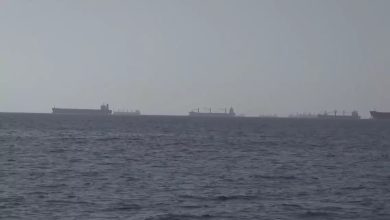
The shipping gridlock visible in satellite imagery and AP photographs around Bandar Abbas (MGRS 40RDU, 27.1833°N, 56.2833°E) and Larak Island (MGRS 40RCT, 26.8500°N, 56.3667°E) represents accumulated vessels unable to enter or exit Iranian ports. The commercial pressure this creates is bilateral. Iran cannot export oil. Gulf states including Iraq and Kuwait, which rely on Hormuz for the great majority of their export capacity, have also had their revenue disrupted. The economic logic of the deal is clear; the political geometry that has prevented it from closing is the question the next phase of talks must resolve.
🟢 The Structure
A Two-Phase Architecture: Near-Term Ceasefire Extension Buys Time for the Hard Questions
The structure of the proposed agreement is intentionally deferral-heavy, and analysts familiar with the negotiating pattern say this is the only architecture that could get both sides to a signing moment. Grajewski's characterisation, published in The Maritime Executive on 24 May, is precise: the deal "pushes some of the hardest questions into less visible side documents while still allowing both sides to announce a political breakthrough." The 60-day track buys time. It does not resolve the underlying disputes; it relocates them.
In the immediate phase covered by the MOU, the mechanisms are relatively straightforward: Iran demines the strait, the US lifts the naval blockade, Iran is permitted to sell oil, and some sanctions are eased. The Financial Times, cited by The Week, adds that gradual easing of restrictions on Iranian ports would also be part of the near-term package. These steps are operationally executable within weeks if both parties are willing.
The 60-day negotiating track that follows is where the weight falls. Nuclear terms, permanent sanctions removal, US asset unfreezing, and the question of Iran's uranium stockpile are all assigned to this period. Axios reported in May that the negotiations might be held in Islamabad or Geneva. The precedent from the first Islamabad round in April is not encouraging: those talks collapsed after 21 hours without a Hormuz deal. Whether Pakistan or another mediator can hold a 60-day format together under the sustained pressure of domestic political criticism in both Washington and Tehran is the operational variable that determines whether the MOU produces a lasting outcome or merely delays the next escalation.
Source Reliability Matrix
NATO grading: REL A (reliable) to F (unreliable). CRED 1 (confirmed) to 6 (cannot judge).
Primary US-side sourcing on deal structure. Background briefings from named US officials. Agreement in principle confirmed; specific nuclear terms disputed by Iran.
Confirmed Iran has accepted uranium export "in principle." Confirmed US agreed to provide "breathing room" without asset release or sanctions lift. Anonymous senior official.
Official Iranian government position delivered on-record by named spokesperson. Reliable for Tehran's stated position; not reliable for a neutral account of deal content. Confirms 14-clause MOU and exclusion of nuclear file from initial framework.
Direct Iranian denial that uranium stockpile transfer was agreed. Background source, identity withheld. Consistent with Baqaei's on-record position.
On-record command authority for 100 ship figure, 200 aircraft/warships, 15,000 troops. These figures are US military self-reporting and are not disputed.
Unconfirmed Iranian-perspective terms: full end to hostilities including Lebanon, asset releases, US force withdrawal, Oman-Iran strait co-governance. No US confirmation. Included as a single-source account of the Iranian side's understanding.
OSINT HQ Assessment
The deal is real, the text is contested, and the gap between what Washington and Tehran are each claiming it says may itself be the obstacle to signing it.
✓ What We Know
A 14-point MOU framework is being negotiated and has been confirmed on-record by Iran's Foreign Ministry and on background by multiple US officials. The deal structure, per both sides, involves a 60-day ceasefire extension, demining and reopening of the Strait of Hormuz, partial Iranian oil sales, and some form of sanctions relief. The US naval blockade has redirected over 100 ships, involves 200-plus naval and air assets, and has been costing Iran an estimated $500 million per day. Trump has told his negotiators not to rush and has confirmed the blockade remains fully active pending a signed, certified agreement.
? What We Do Not Know
The actual text of the 14-point document. Whether Iran has genuinely agreed to uranium stockpile transfer in principle, or whether US officials are describing an aspiration as a commitment. Whether the Oman-Iran joint strait control framing in Iranian state media represents a genuine clause in the MOU or a post-hoc framing of the deal for domestic consumption. Whether a 60-day negotiating track will produce the nuclear resolution the US requires, or will collapse the way the first Islamabad round did. The timing and venue for the next phase of talks.
☉ What To Watch
Whether Trump moves from "not rushing" back to threatening military action if talks stall. Whether Pakistan Army Chief Munir's 23 May Tehran visit produces a written mediator's summary that can narrow the US-Iran gap on what the MOU actually says. Whether the Republican critics' noise translates into Senate action that constrains a White House deal. Whether demining operations begin as a confidence-building measure before the MOU is signed. Oil price movement: a Brent drop below 100 dollars per barrel would signal markets are pricing a signed deal; a spike would signal collapse.
Sources
- Deal to Reopen Hormuz Gets Closer, But With Little Agreement in Public, The Maritime Executive, 24 May 2026
- Exclusive: What's inside the Iran deal Trump is close to signing, Axios, 24 May 2026
- Live Updates: Iran-US negotiators agreed to broad principles, CBS News, 24 to 25 May 2026
- US-Iran deal said to open strait for 60 days, Times of Israel, 24 May 2026
- Trump says he won't rush into a deal with Iran, NBC News, 24 May 2026
- Trump touts Iran breakthrough but details remain unclear, NPR, 23 to 24 May 2026
- The US and Iran near deal to extend ceasefire and reopen Hormuz, Washington Post, 24 May 2026
- Iran and US say could be close to agreement, Trump to assess draft deal, Arab News, 23 May 2026
- MOU Being Finalized, Baqaei statement, Tasnim News Agency, 23 May 2026
- 100 ships redirected amid naval blockade, The Hill / CENTCOM statement, 24 May 2026
- Republican leaders Lindsey Graham, Cruz slam reported 60-day Iran deal, Jerusalem Post, 24 May 2026
- Trump not rushing Iran deal, CNBC, 24 May 2026
- Iran deploys more mines in the Strait of Hormuz, Axios, 23 April 2026
- To avoid risk of mines, Navy directs ships on path farther from Iran in Strait of Hormuz, CBS News, May 2026
Editorial Verification
The existence of a 14-point MOU framework is verified through parallel confirmation by Iran's Foreign Ministry spokesman Baqaei (on-record, Tasnim and IRIB, 23 May) and multiple US officials briefed to Axios, the Wall Street Journal, and CBS News (24 May). The 60-day ceasefire extension structure is corroborated by the Financial Times (cited by The Week), Axios, Times of Israel, and ABC News. Trump's TruthSocial posts of 23 and 24 May are primary-source materials quoted in multiple wire reports including NBC News, NPR, and CNBC. The nuclear-file contradiction between US and Iranian accounts is a genuine documented discrepancy present across all primary sources and is presented as such in this report, not resolved editorially. The Al Jazeera/Hashem account of Iranian-side deal terms is single-source and flagged accordingly. The CENTCOM 100-ship blockade figure is a primary public-statement source. Republican opposition statements by Wicker, Cruz, and Pompeo are verified through Times of Israel and CNBC reporting. The $500 million daily cost figure is sourced to the Defense Department estimate cited by CENTCOM reporting in May 2026.
Coordinates and map (v8): All geographic reference points are PRECISE, sourced from GeoNames gazetteer and Wikipedia infobox coordinates for named features: Strait of Hormuz narrows (Wikipedia infobox, GeoNames), Bandar Abbas (GeoNames), Larak Island (GeoNames), and Khasab/Musandam (GeoNames). No coordinates were generated. MGRS derived from sourced lat/lon for each point. Static map produced with PIL overlay script sb-map-overlay.py on a satellite base image. Third-party watermarks removed from base before overlay. Strike markers and territory fills are approximate per open-source reporting. No classified imagery used. No third-party watermarks appear in the published image.
MGRS datum: WGS84 / UTM Zone: 40R / Cross-check reference: Bandar Abbas city centre 40RDU 05500 74000
All claims independently attributed and verified to open sources where possible.
Approved for Publication
Marcus V. Thorne
Lead Editor, OSINT HQ
©osinthq.org 2026
This article is for news and analysis purposes only. Based on publicly available news sources and military updates. All rights reserved. Not for commercial reuse without permission.